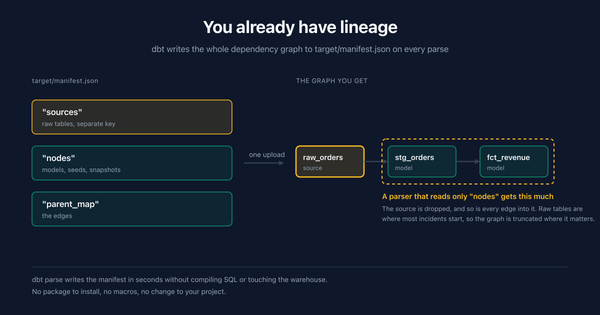
How to Get Lineage From a dbt Manifest Without a Migration
Your dbt project already contains a complete dependency graph. It is sitting in target/manifest.json, and getting it out takes one command.

Your dbt project already contains a complete dependency graph. It is sitting in target/manifest.json, and getting it out takes one command.
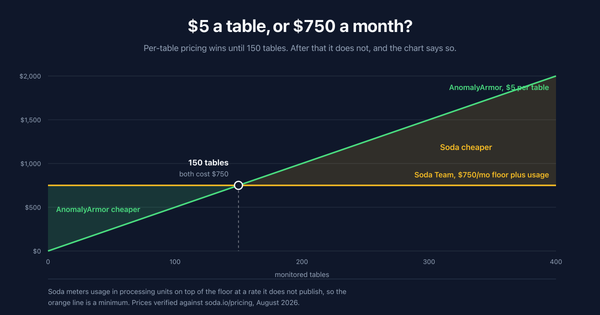
Soda's 2026 pricing is public, Soda Core is no longer open source, and nobody exports to ODCS. An honest comparison, including where Soda wins.
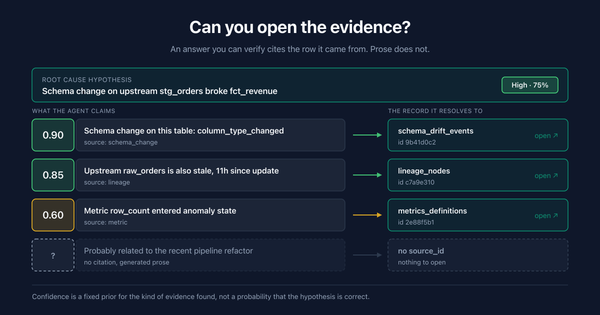
An agent's confidence score tells you what kind of evidence it found, not whether it is right. Four checks that separate a citation from a guess.
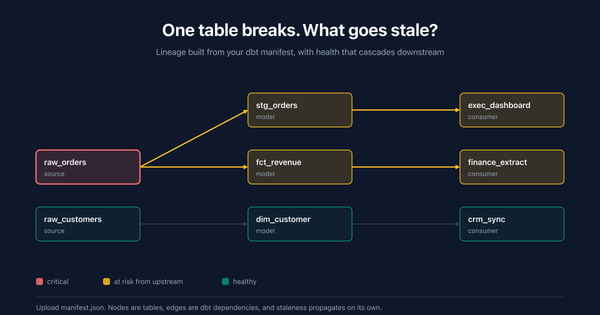
One table breaks and forty alerts follow. Lineage turns that noise into a named root cause and a list of exactly what went stale.
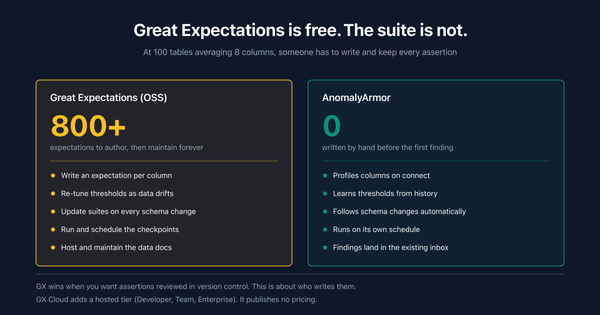
Great Expectations is free to install and expensive to maintain. What the alternatives change, and how to port your suites without losing them.
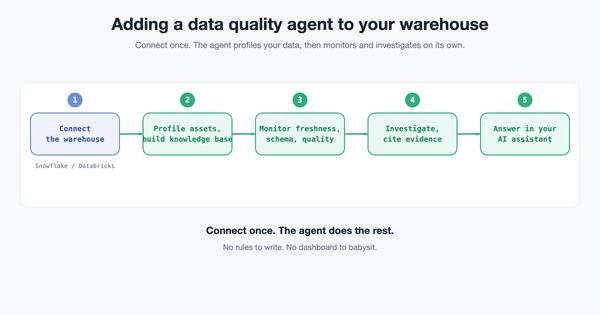
Setting up a data quality agent on Snowflake or Databricks takes one connection, not a test-writing project. Connect the warehouse, let the agent profile your tables and build its knowledge base, and it starts monitoring and investigating on its own. Here's the walkthrough.
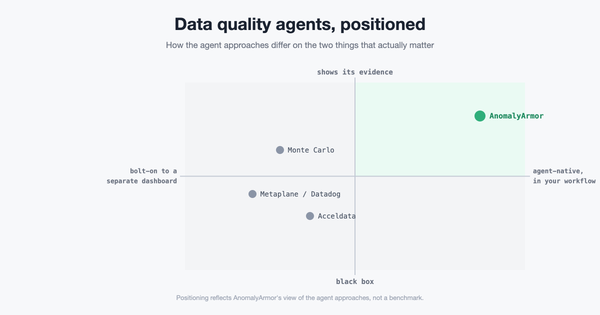
Monte Carlo, Acceldata, and Datadog's Metaplane all ship data quality agents now. Most are a language model bolted onto a legacy dashboard. Here's an honest comparison of the agent approaches and where an agent-native tool fits.
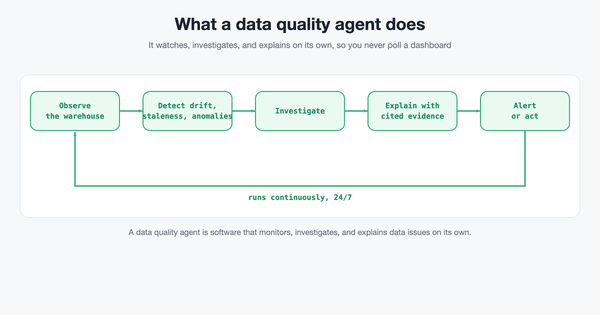
A data quality agent is software that watches your warehouse, investigates problems, and explains them on its own, instead of making you check a dashboard. Here's what that means, how it differs from rule-based monitoring, and why the category showed up in 2026.
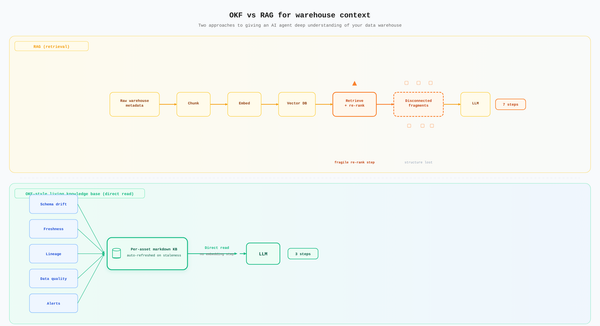
Google's Open Knowledge Format (OKF) formalizes the "LLM Wiki" pattern: give an agent a curated markdown knowledge base instead of RAG over raw chunks. We've run a variation of that for warehouse context since 2025. Here's why a living knowledge base beats RAG, and where RAG still wins.
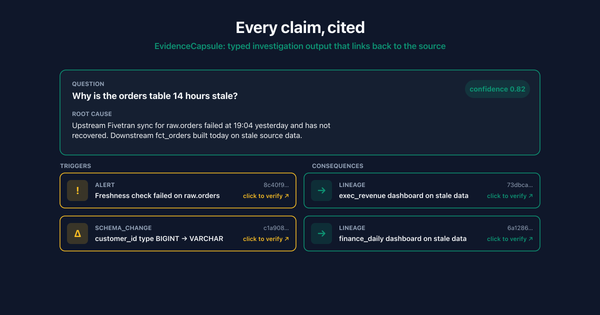
When an AI agent answers "why is this table stale?" the hardest question is whether you can trust the answer. EvidenceCapsule is a typed investigation output where every claim cites the row it came from, so you can click through and verify.
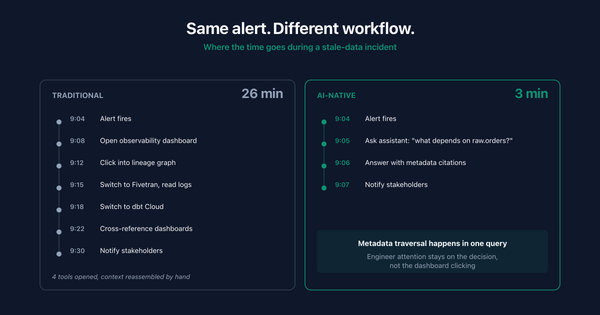
Most data observability tools shorten the time to know something broke. AI-native observability shortens the time to know what broke, what depends on it, and what to do next. Here is what that workflow actually looks like during a real incident.
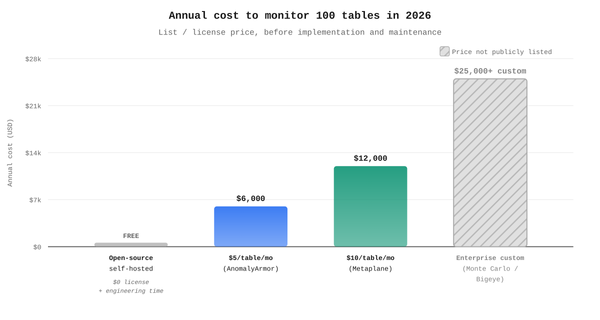
Data observability costs range from $0 open-source (you pay in engineering time) to five-figure enterprise contracts. This guide breaks down every pricing model, the hidden costs nobody quotes, and a total-cost formula you can run on your own warehouse before any sales call.
Data Quality
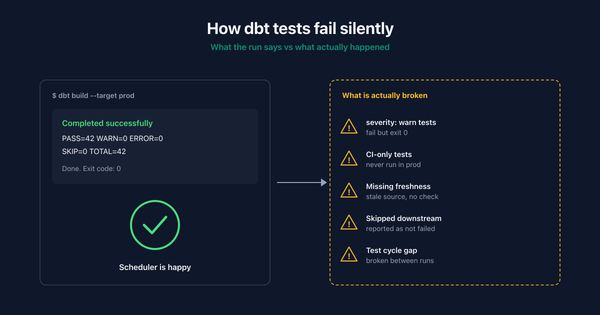
dbt tests fail silently more often than they fail loudly. Warn-severity tests, skipped models, freshness gaps, and tests that only run in CI all let bad data through without paging anyone. This guide covers the patterns that hide failures and how to catch them.
Data Quality
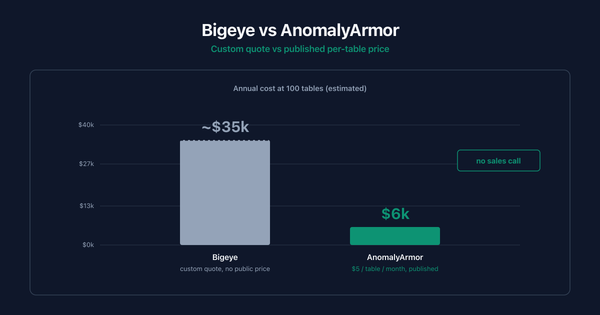
Bigeye is an enterprise data observability platform priced for enterprise procurement. An honest comparison with AnomalyArmor: what Bigeye does well, where its pricing and sales model is a mismatch for mid-market teams, and when each tool is the right call.
Data Quality
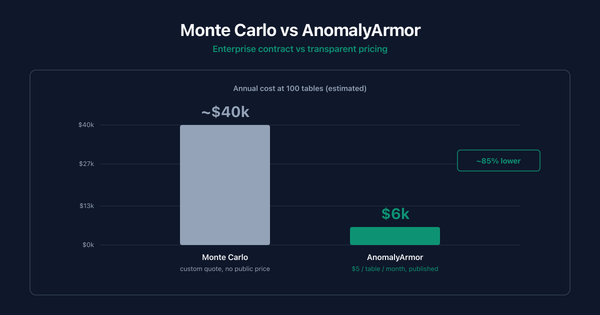
Monte Carlo is the enterprise standard, with enterprise pricing to match. In March 2026 it cut 30% of staff. An honest comparison with AnomalyArmor: what Monte Carlo actually costs, what the restructuring means for buyers, and when each tool is the right call.
Data Observability
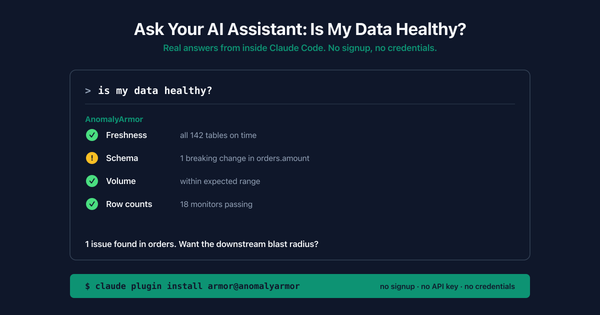
Cold outreach converts at 0% when prospects must hand warehouse credentials to a stranger's SaaS. We shipped a Claude Code plugin that runs against a real demo warehouse with no signup, API key, or credentials. How we built it on existing infra, and what we chose not to build.
Data Quality
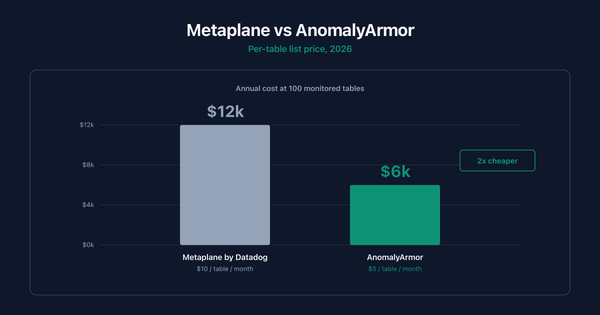
Metaplane is now Metaplane by Datadog. If you picked it to stay off an enterprise observability platform, the acquisition changes the math. An honest comparison with AnomalyArmor: pricing, features, the Datadog question, and when each is the right call.
Data Quality
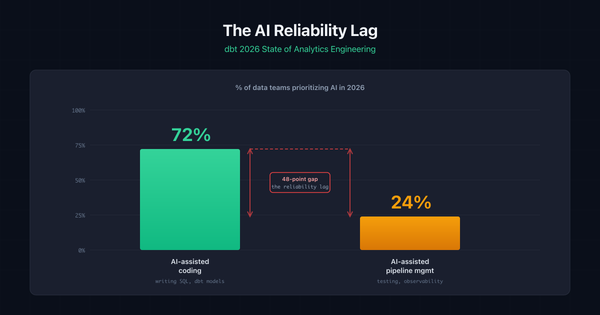
dbt's 2026 State of Analytics Engineering found that 72% of data teams prioritize AI-assisted coding, but only 24% prioritize AI-assisted pipeline management. That 48-point gap is the reliability problem nobody's talking about: AI is writing the pipelines but not keeping them alive.
Data Quality
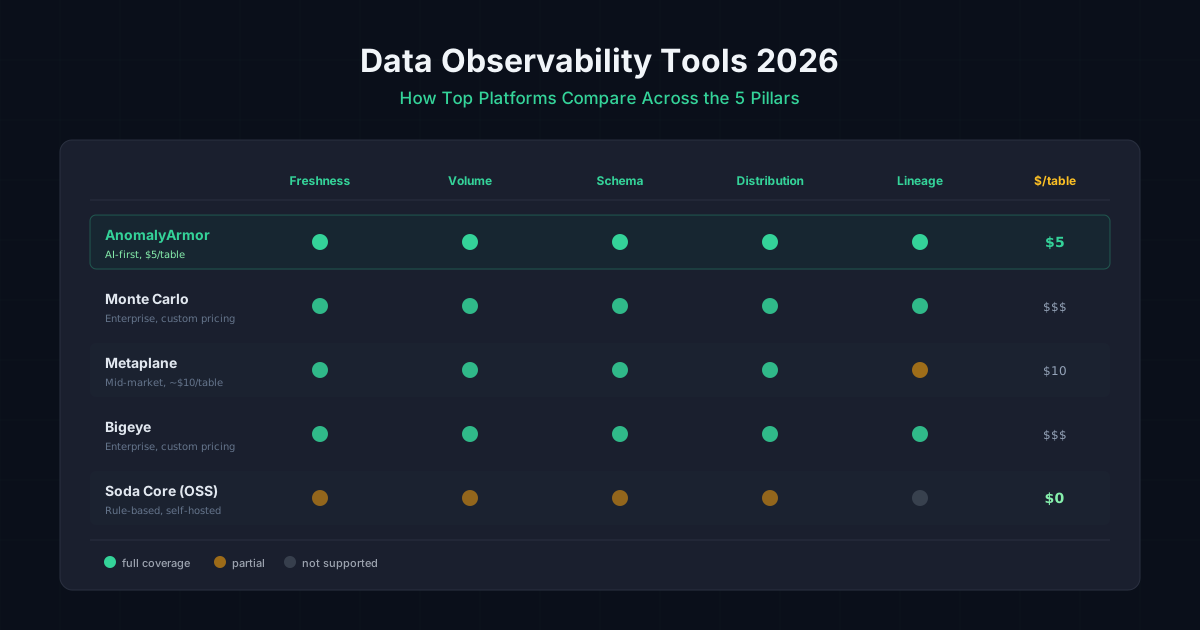
The best data observability tools in 2026 are AnomalyArmor, Monte Carlo, Metaplane, Bigeye, Soda, Datafold, Great Expectations, Elementary, Atlan, and DataHub. This guide compares pricing, features, and trade-offs to help you choose.
Data Quality
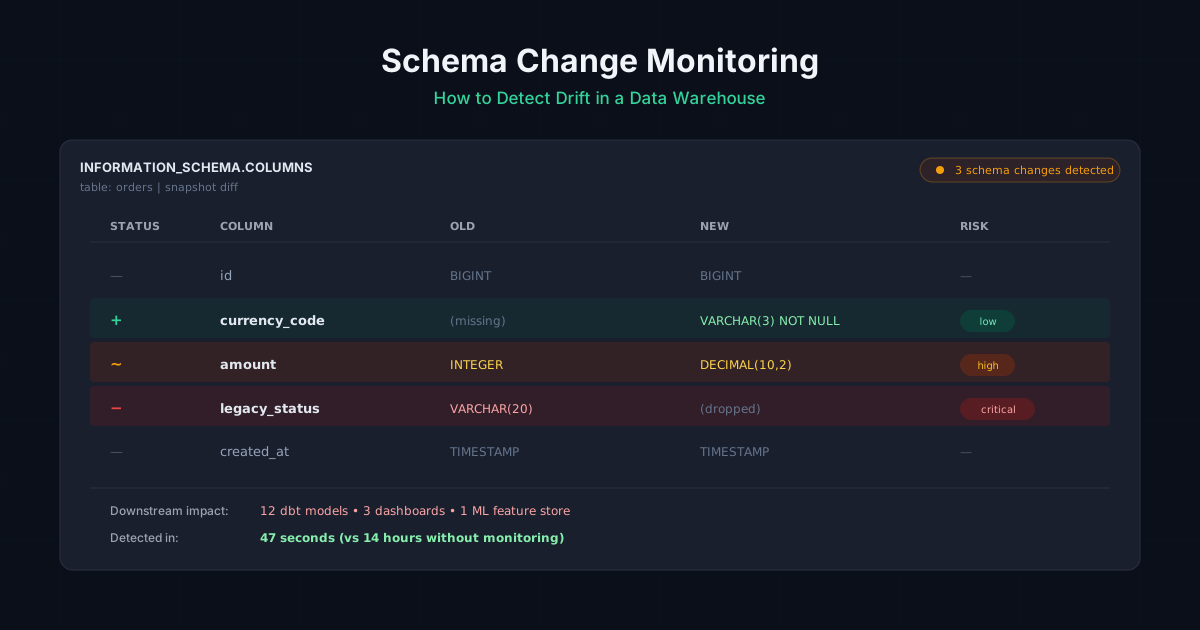
Schema changes in a data warehouse are monitored by polling INFORMATION_SCHEMA, using event-driven triggers, or comparing column hashes. This guide covers detection methods with SQL examples for Snowflake, Databricks, and PostgreSQL, plus a comparison of automated tools.
Data Quality
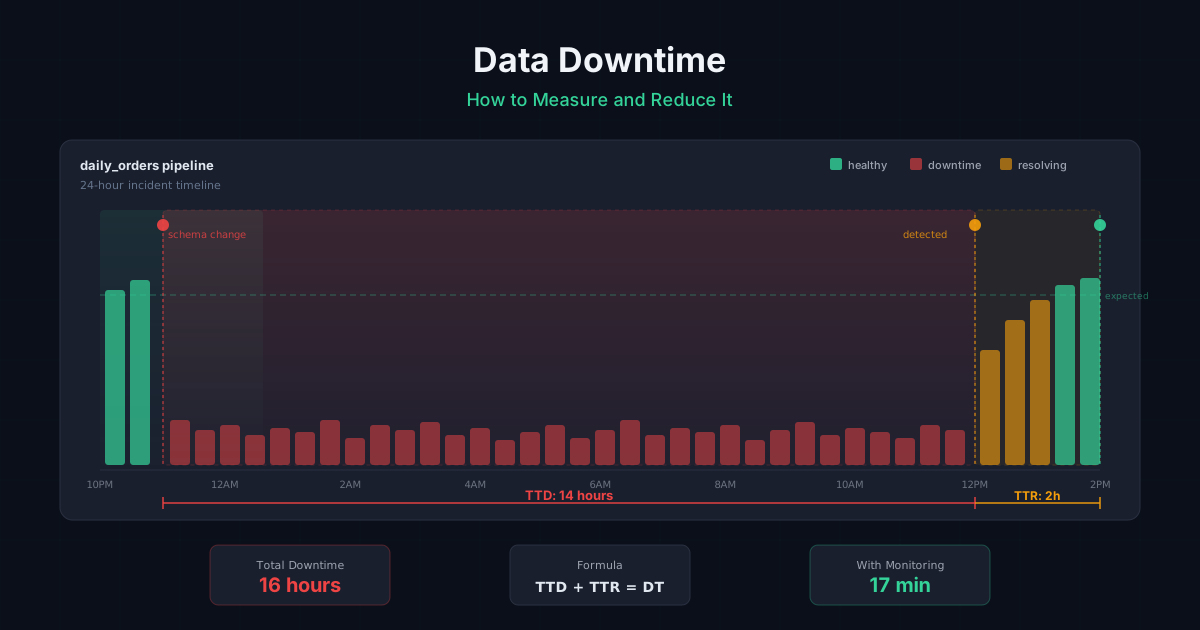
Data downtime is the total time your data is missing, inaccurate, or otherwise unusable. This guide explains how to calculate it using TTD and TTR, estimate the dollar cost per hour, reduce it with automated monitoring, and benchmark your team against industry norms.
Data Quality
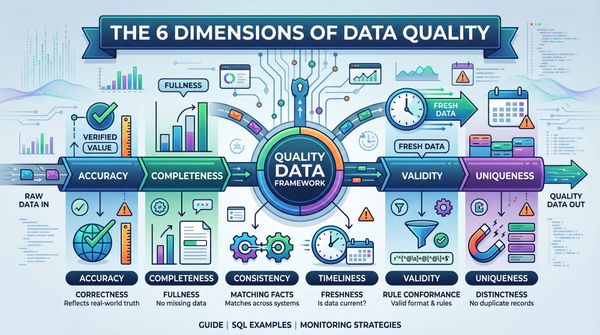
The six dimensions of data quality are accuracy, completeness, consistency, timeliness, validity, and uniqueness. This guide defines each dimension with SQL examples and shows how to monitor all six in production data pipelines.
Schema Drift
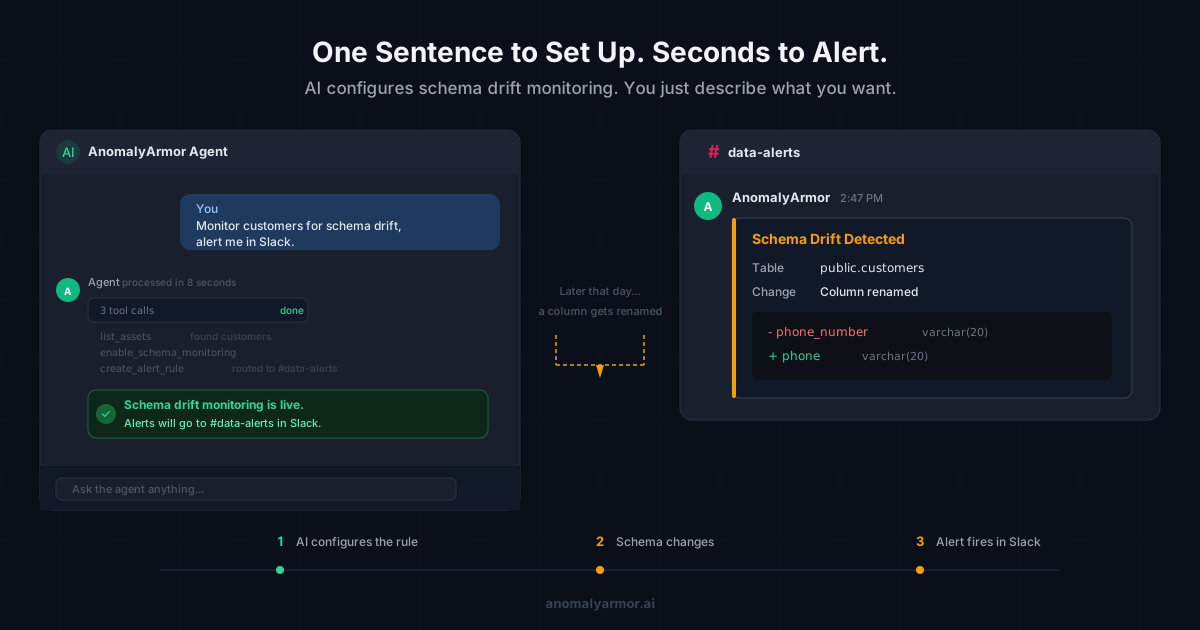
Set up schema drift observability in seconds

Data Quality
Data engineers know they should test their pipelines. They just don't have time. The real answer isn't better testing frameworks. It's automated data testing that works without writing a single test.