What Is the Best Elementary Alternative in 2026?
Elementary is genuinely open source and genuinely good. The question is what happens to the tables dbt never touches, and what June's merger changed.
Elementary is a dbt-native data observability tool that runs as a dbt package plus a CLI, storing its results in your warehouse and reporting on the models dbt builds. It is Apache 2.0 licensed, which in 2026 is worth saying out loud, because most of its competitors have quietly stopped being open source.
I sell a competing product, so read accordingly. What I can do is be precise about where Elementary's design ends, because that boundary is the entire decision and it is not a quality question.
What does Elementary actually do?
It installs into your dbt project. You add the package, run dbt run and dbt test as usual, and Elementary collects the artifacts dbt produces, stores them in a schema in your warehouse, and builds a report on top.
That architecture buys three things worth having:
- It knows your models. When a table changes it can name the model that produced it, the test that failed, how long the run took, and the shape of the DAG around it.
- It runs where your data lives. No warehouse credentials handed to a vendor, because the compute is your compute and the storage is your storage.
- It's configuration as code. Monitors are declared in YAML alongside the models, reviewed in pull requests, versioned in Git.
The OSS version includes anomaly detection tests, automated freshness and volume monitors, a data quality dashboard, model performance tracking, a catalog, and Slack or Teams alerting. That is a lot of product to give away, and it is Apache 2.0, meaning you can actually use it however you like.
Elementary Cloud adds hosting, column-level lineage from source through BI, a built-in catalog, AI agents, and incident management. Pricing is sales-quoted, tiered on both editor seats and table count: the entry tier covers up to 10 editor seats and 1,000 tables, with more billed per additional thousand.
What does the config actually look like?
Worth seeing both, because the difference in shape is the difference in philosophy.
Elementary monitors live in your dbt project, declared next to the model they watch:
# models/marts/schema.yml
models:
  - name: fct_revenue
    config:
      elementary:
        timestamp_column: created_at
    tests:
      - elementary.volume_anomalies:
          timestamp_column: created_at
      - elementary.freshness_anomalies:
          timestamp_column: created_at
    columns:
      - name: order_total
        tests:
          - elementary.column_anomalies:
              column_anomalies: [null_count, average]
Then it runs as part of your normal dbt invocation:
dbt deps
dbt run --select elementary
dbt test
edr send-report          # the CLI builds and ships the report
That is a coherent design. The monitor lives with the model, it is reviewed in the pull request that adds the model, and there is one scheduler because dbt is already the scheduler.
The warehouse-native shape inverts it. Monitors are generated from the tables themselves and exported as a contract, so the config is a description of what is being watched rather than an instruction to watch it:
armor contract pull --asset <uuid> -o orders.yaml
Neither is better in the abstract. The dbt-native version is tighter when everything is dbt, and it has no answer for the table dbt never sees, because there is no schema.yml entry to hang a monitor on.
Where does dbt-native stop?
Here is the boundary, and it's structural rather than a gap somebody forgot to fill.
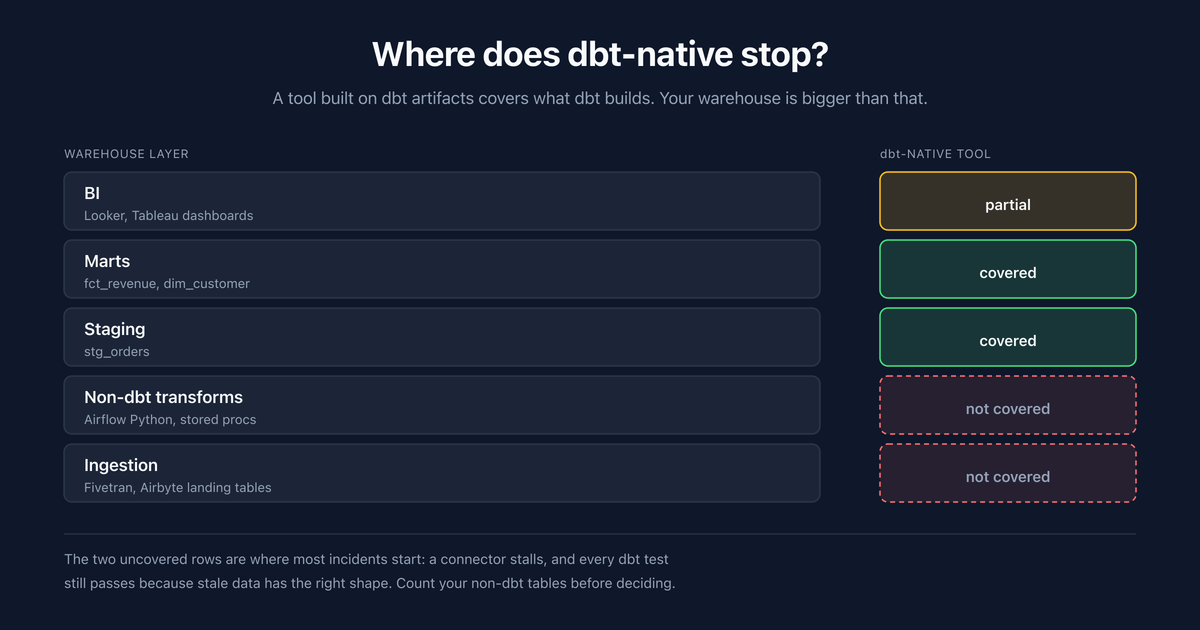
Elementary observes what dbt builds. Your warehouse contains more than that:
- Raw tables that Fivetran, Airbyte, or Stitch land before dbt reads them
- Reverse ETL outputs pushed to Salesforce or HubSpot
- Tables written by Airflow tasks that call Python rather than dbt
- Stored procedures, scheduled queries, an analyst's materialized view
- Anything from an acquisition, another team, or the four years before you adopted dbt
For a shop where every table flows through dbt, this list is empty and Elementary's coverage is total. That shop exists. It is usually younger than five years and has one data team.
For everyone else, the gap sits precisely where incidents start. A Fivetran connector breaking is the single most common cause of a stale dashboard, and the raw table it writes is upstream of dbt by definition. dbt runs fine. Your models transform stale data successfully and every test passes, because the tests check shape and the data has the right shape. It is simply old.
That's the same failure I wrote about in silent dbt test failures, one layer earlier. Tests answer questions you thought to ask about tables dbt owns. Freshness on a source table is neither.
What did the Fivetran merger change?
Fivetran completed its merger with dbt Labs on June 1, 2026, announced the previous October. George Fraser stays CEO, Tristan Handy is President.
For dbt users the immediate news was good: dbt Core v2.0 alpha open-sources the Fusion engine runtime under Apache 2.0, which puts capabilities that were commercial into the free distribution.
The relevant question for this post is what it means to bet your observability layer on being dbt-native. Two readings, and I hold both.
The optimistic one: dbt just got a much larger parent with an ingestion business attached, which means more investment and a plausible future where ingestion and transformation share a control plane. Tools deeply integrated with dbt benefit from dbt being better funded.
The cautious one: the merged company now owns both ingestion and transformation, and observability across that boundary is the obvious next thing to build. When a platform vendor moves into your category, being deeply coupled to that platform is a strategic position rather than only a technical one.
I don't know which way it goes and neither does anyone else. It's worth naming because "dbt-native" reads as a pure integration choice, and after June 1 it is also a bet on a specific vendor's roadmap.
What are the alternatives?
Four directions, depending on what's driving you.
| If you're leaving because | Look at | Trade-off |
|---|---|---|
| Coverage stops at dbt | AnomalyArmor, Monte Carlo, Bigeye | You lose dbt-model awareness, gain warehouse-wide coverage |
| You want hosting without Cloud pricing | AnomalyArmor, Metaplane (now Datadog) | Per-table or per-usage pricing instead of seats plus tables |
| You need incident management at scale | Monte Carlo, Bigeye | A much larger price tag and a sales cycle |
| You want checks as explicit artifacts | Soda, Great Expectations | More authoring, no auto-baseline |
Honestly: if you're happy with Elementary and your stack is all dbt, there is no reason in this post to switch. The strongest case for moving is coverage, and the second strongest is that you don't want to operate the OSS version and don't want a sales-quoted Cloud contract.
AnomalyArmor connects to the warehouse instead of the dbt project, so it sees every table regardless of what wrote it, and generates baseline monitors without you authoring them. Published price, $5 per monitored table per month. What you lose is real: we don't know that fct_revenue came from a model called fct_revenue, only that the table is healthy or isn't. If your mental model is organized around dbt, ours will feel less precise.
Monte Carlo and Bigeye are the enterprise answer, with lineage and incident management to match, at a cost that starts well above both options here.
Soda and Great Expectations are the opposite philosophy, where every check is hand-written and explicit. I compared those in the Soda and Great Expectations posts.
How do the costs actually compare?
Three cost shapes, and the free one is not free.
Elementary OSS costs $0 in license and a real amount in operation. You run the package on every dbt invocation, store artifacts in your warehouse, and host or serve the report yourself. Call it an afternoon to set up and a few hours a quarter of maintenance, plus the warehouse storage and compute the artifact tables consume. That is a genuinely good deal if you have the hours, and a bad one if your data team is two people who are already behind.
Elementary Cloud is sales-quoted, so I can't put a number on it honestly. What I can tell you is the shape: seats plus tables, tiered, with an AI add-on billed on credits. Two axes means forecasting requires knowing both your team's growth and your warehouse's, and credit-based add-ons are the line item that surprises people.
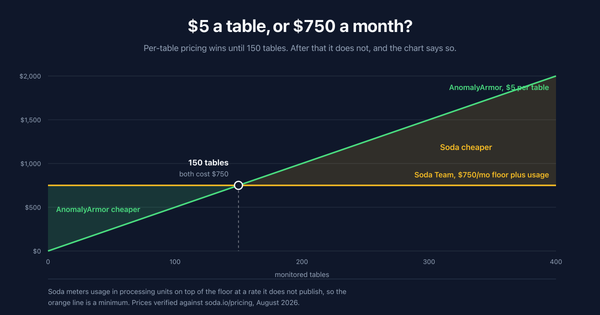
AnomalyArmor is $5 per monitored table per month. 200 tables is $1,000 a month, and that number does not change when you hire.
The comparison you should actually run is against your table count and your team's tolerance for operating things. If you have 300 tables and one person who enjoys infrastructure, OSS wins on cost by a wide margin. If you have 60 tables and nobody with spare hours, hosted wins.
Can you run both?
Yes, and for a lot of teams this is the correct answer rather than a diplomatic dodge.
They cover different layers. Elementary knows your dbt project: which model failed, which test, how long it ran, what the DAG looks like. A warehouse-level monitor knows whether tables are fresh, whether schemas drifted, and whether volumes look normal, including for the tables dbt never sees.
The sensible split is Elementary for everything inside the dbt project and a warehouse-level tool for the ingestion layer and whatever else exists. The cost is two alerting surfaces, which is a real cost and the reason people don't do it.
If you do run both, route them to different Slack channels and be deliberate about which questions each one answers. Two tools alerting into one channel about the same incident is how you train a team to ignore both.
Which layers does each tool actually see?
The coverage question is easier to settle if you draw the warehouse as layers and mark who watches each one.
| Layer | What lives there | Elementary | Warehouse-native |
|---|---|---|---|
| Ingestion | Fivetran, Airbyte, Stitch landing tables | Only if declared as dbt sources, and then partially | Yes |
| Staging | stg_ models |
Yes, in detail | Yes |
| Marts | fct_, dim_ models |
Yes, in detail | Yes |
| Non-dbt transforms | Airflow Python, stored procs, scheduled queries | No | Yes |
| Reverse ETL | Tables pushed to Salesforce, HubSpot | No | Yes, as tables |
| BI | Looker, Tableau, Metabase | Cloud tier, via column-level lineage | Only where modeled |
Two rows deserve a footnote rather than a checkmark.
Declaring a raw table as a dbt source gets it into the dbt graph, and Elementary can run freshness checks on sources. So the ingestion row is not a flat no. What you get is freshness on the sources you remembered to declare, which is a subset of the tables that exist, and the subset shrinks over time because declaring sources is a chore nobody schedules.
The BI row is the one where Elementary Cloud is ahead of us and I'd rather say so. Column-level lineage from source through to the dashboard is genuinely more than we do; we stop at the table and we're table-level throughout.
Run the exercise on your own warehouse before you take anyone's grid at face value, including this one. List your tables, mark which are dbt-produced, and the answer usually surprises the person who runs it. I've yet to see a warehouse older than three years where the number was above 80%.
When Elementary is the right call
Four situations where I'd tell you to stay, and I mean them.
Everything genuinely flows through dbt. Then the coverage argument, which is most of this post, evaporates. You get deeper model-level detail than a warehouse-level tool can offer, for free.
You want the data to stay in your warehouse. Elementary OSS never sends your data anywhere because it runs inside your own compute. For teams with strict data residency rules or a security review that treats a vendor connection as a project, that is worth more than any feature comparison.
Your team likes operating things. If you have someone who enjoys infrastructure, running the OSS version is a small ongoing cost and the license is $0. Paying $1,000 a month for 200 tables to avoid work you'd enjoy doing is a bad trade.
You need model performance data. Elementary tracks how long each model takes across runs, which is genuinely useful for warehouse spend and which a table-level monitor has no way to know. That's a dbt-artifact feature and only a dbt-native tool can offer it.
The pattern in all four: Elementary's design is a real design, not a compromise. It made a choice about scope and executed it well. The reason to look elsewhere is that your warehouse doesn't match that scope, and the way to find out is to count.
What should you check before switching?
Four things, in the order they'll actually matter.
- Count your non-dbt tables. Open your warehouse, list the tables, and mark which ones dbt produces. If it's 95%, Elementary's boundary is theoretical for you. If it's 60%, you have been monitoring a fraction of your surface and probably didn't know the number.
- Ask where the last three incidents started. Not which dashboard broke, which table broke first. If the answer is repeatedly a raw table, your observability is in the wrong layer.
- Price the operating cost honestly. If you're on OSS, the question isn't $0 versus a bill. It's $0 plus your hours versus a bill and no hours, and hours have a rate.
- Test the migration before committing. Elementary is dbt-native, so your test definitions are
schema.ymlentries and those port cleanly.armor migrate-from dbt ./my-dbt-project/translates them into ODCS, which imports directly. Elementary's anomaly monitors have nothing to convert, because an auto-baseline tool generates its own.
That last point deserves a caveat I'd rather state than have you find: the translation covers standard schema.yml tests. Singular tests, custom generic tests, and Elementary-specific config stay where they are. Anything the adapter can't convert is reported rather than dropped, but "reported" still means you handle it.
Frequently asked questions
What is the best Elementary alternative in 2026?
It depends on why you're looking. For warehouse-wide coverage beyond dbt, AnomalyArmor, Monte Carlo, or Bigeye. For hosting without a sales-quoted contract, AnomalyArmor. For hand-authored explicit checks, Soda or Great Expectations. If your stack is entirely dbt and Elementary is working, staying is a legitimate answer.
Is Elementary open source?
Yes, Apache 2.0, which is genuine open source rather than source-available. The OSS version includes anomaly detection, automated monitors, a dashboard, a catalog, and Slack alerting. Elementary Cloud is the commercial hosted product.
How much does Elementary Cloud cost?
Not published. It is sales-quoted and tiered on both editor seats and table count, with the entry tier covering up to 10 editor seats and 1,000 tables and more billed per additional thousand. An AI layer is available as a credit-based add-on.
Can Elementary monitor my raw ingestion tables?
Partially. Declaring a raw table as a dbt source puts it in the graph and lets Elementary run freshness checks on it. The catch is that this covers the sources you remembered to declare, which drifts below the set of tables that actually exist, because declaring sources is a chore nobody schedules.
Does Elementary give me column-level lineage?
Elementary Cloud does, from source through to BI. That is more than we do, since we are table-level throughout. If tracing a single column across the stack is the job, that is a point in their favour and I would rather say so than leave it out.
Does Elementary monitor tables outside dbt?
Its architecture is built on dbt artifacts, so its coverage follows your dbt project. Raw ingestion tables, reverse ETL outputs, and anything written by a non-dbt job sit outside that boundary.
Why does non-dbt coverage matter?
Because incidents usually start upstream of dbt. A broken ingestion connector leaves a stale raw table; your models then transform it successfully and your tests pass, since the data has the right shape and is merely old.
Did the Fivetran and dbt Labs merger affect Elementary?
Not directly, and I have seen no announcement suggesting it did. It is worth factoring into a multi-year decision, since the merged company now owns both ingestion and transformation and observability across that boundary is adjacent territory.
Is Elementary OSS really free?
The license is free. Operating it is not: you run it on every dbt invocation, its artifacts consume warehouse storage and compute, and you host the report. Cheap if you have the hours, expensive if you don't.
Can I use Elementary and a warehouse monitor together?
Yes, and it is often the right call. Elementary covers the dbt project in detail, the warehouse tool covers ingestion and everything non-dbt. Route them to separate channels so one incident doesn't produce two conversations.
How do I migrate Elementary tests to another tool?
Your test definitions are schema.yml entries, so it's a dbt-test migration. armor migrate-from dbt translates the standard types into ODCS YAML. Singular and custom generic tests stay in dbt.
What happens to Elementary's anomaly monitors when I migrate?
Nothing converts, because they don't need to. A tool that generates its own baseline from warehouse history rebuilds that layer itself. Only your explicit assertions are worth porting.
Does AnomalyArmor know which dbt model produced a table?
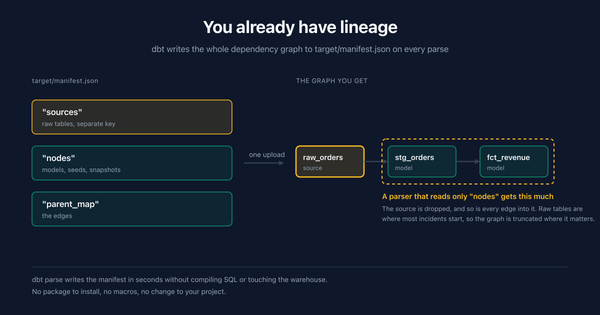
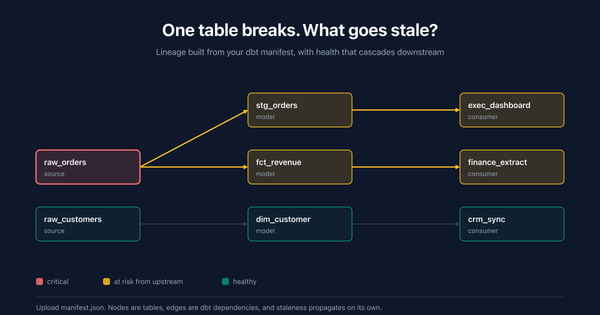
Only if you upload your dbt manifest, which gives us the graph but not the run-level detail Elementary has. We know table relationships and health, not that a specific model's run took 40% longer than usual.
Does Elementary track dbt model performance?
Yes, run durations per model across time, which is useful for warehouse spend and for catching a model that has been quietly degrading. It is a dbt-artifact feature, so a table-level warehouse monitor has no way to produce it.
Is dbt-native a risk after the merger?
It is a consideration rather than a risk. dbt is better funded than before and dbt Core v2.0 open-sourced the Fusion runtime under Apache 2.0. The thing to weigh is that deep coupling to any platform is partly a bet on that platform's roadmap.