Data Quality Agents Compared: Monte Carlo, Acceldata, and the Agent-Native Approach
Monte Carlo, Acceldata, and Datadog's Metaplane all ship data quality agents now. Most are a language model bolted onto a legacy dashboard. Here's an honest comparison of the agent approaches and where an agent-native tool fits.
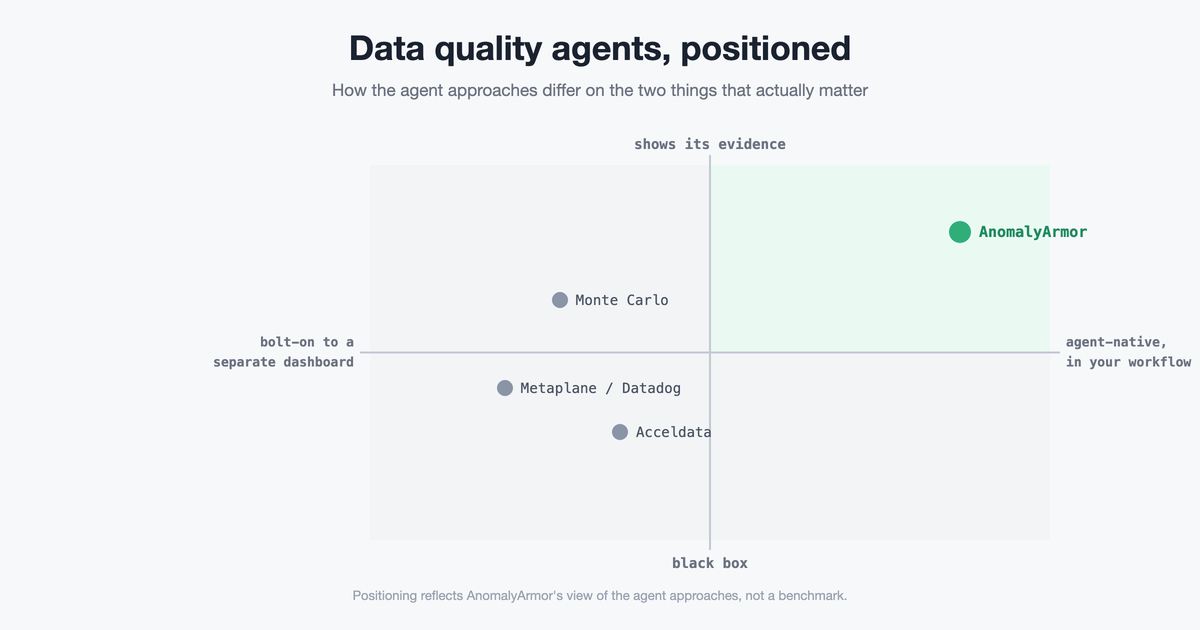
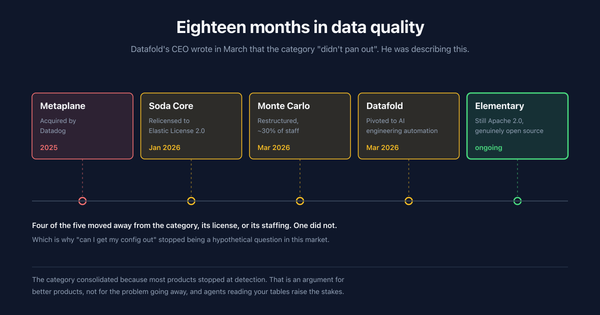
Every data observability vendor shipped a "data quality agent" in the last year, and they are not the same thing. Monte Carlo added Observability Agents to its platform in April. Acceldata sells a Data Quality Agent inside its agentic data management suite. Datadog is folding Metaplane into its stack after the 2025 acquisition. On paper they all promise the same thing: an agent that monitors, investigates, and resolves data issues. In practice they split into two camps, and the split matters more than any feature checklist.
The short version: the incumbents added an agent to a dashboard you already pay a lot for. The agent-native approach makes the agent the product and drops the dashboard. Which one you want depends on whether you already run one of these platforms and how much you care about verifying what the agent tells you.
The two camps
Agent-as-a-feature. Monte Carlo, Acceldata, and Metaplane are mature observability platforms. Their agents are a new capability layered on top of the existing product: the same warehouse of alerts, dashboards, and lineage, now with an LLM that can summarize an incident or suggest a root cause. You still log into their console. The agent is a helper inside a tool you were already using.
Agent-native. The agent is the whole product. There's no separate dashboard to live in. The agent watches the warehouse, investigates issues, and answers you where you work, usually through your existing AI assistant or a chat surface. AnomalyArmor is built this way. So, increasingly, are newer entrants like DQLabs' Prizm.
Neither camp is automatically right. If your org has standardized on Monte Carlo and has three engineers who live in its console, its agent is a reasonable add-on. If you're a smaller team that doesn't want to run and pay for a heavy platform just to get an agent, the native approach is a better fit.
How the agent approaches compare
| Monte Carlo Agents | Acceldata | Metaplane / Datadog | Agent-native (AnomalyArmor) | |
|---|---|---|---|---|
| What the agent is | Feature on the platform | Feature in the suite | Feature, folding into Datadog | The entire product |
| Where you work | Their console | Their console | Datadog | Your AI assistant, or a chat surface |
| Investigation output | Prose summary + RCA | Automated find/fix | Summaries | Cited evidence, every claim links to a record |
| Setup | Platform onboarding | Platform onboarding | Datadog integration | Connect warehouse, agent profiles it |
| Pricing shape | Enterprise, seat + volume | Enterprise | Aligning to Datadog | $5 per table |
| Best for | Existing MC customers | Large data estates | Datadog shops | Teams who want the agent, not a platform |
A few honest caveats about this table. The incumbent platforms are genuinely more mature on breadth: years of connectors, enterprise controls, and scale that a newer tool hasn't matched. If you need to monitor thousands of tables across a dozen sources with fine-grained RBAC today, that maturity is worth something. The agent-native tools trade that breadth for a simpler surface and, in the good ones, better verifiability.
The question that actually separates them
Feature tables blur together. The question that doesn't: when the agent tells you something, can you check it?
This is the thing to press every vendor on. An agent that produces a confident paragraph explaining your incident is only useful if you can verify the paragraph. Otherwise you've replaced "I don't know what broke" with "a model told me what broke and I can't tell if it's right," which is not an upgrade. The failure mode of agentic analysis isn't that it's dumb. It's that it's plausible and wrong, and plausible-and-wrong is expensive when you act on it during an incident.
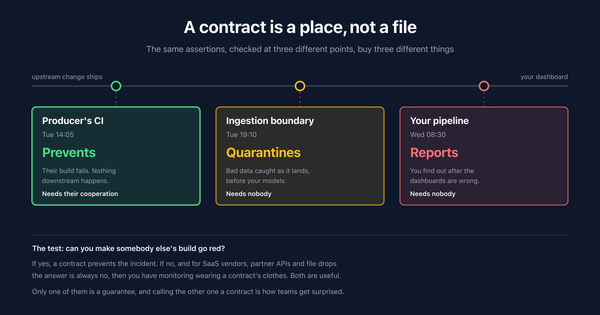
Our answer is that every claim an AnomalyArmor investigation makes is a citation. When it says a freshness check failed at 9:04 against a schema change from the night before, both facts are links to the actual records, and you click through to confirm. We wrote up how that works in Citations for Your Data Incidents. Some of the incumbents are moving toward this; most still hand you prose. Ask for a live investigation in the demo and see whether you can click into the evidence, or whether you're being asked to trust the narration.
Where cost comes in
The agent-as-a-feature tools carry the pricing of the platform underneath them. That's fine at enterprise scale and painful for a mid-sized team that just wants an agent watching its warehouse. Monte Carlo and Acceldata are enterprise contracts. Metaplane's pricing is expected to drift toward Datadog's now that it's part of that stack.
AnomalyArmor is $5 per table, which is roughly half of what Metaplane charged before the acquisition. The reason we can do that is the same reason we're agent-native: there's no heavy platform to fund, so the agent doesn't have to carry a platform's price tag. We went deeper on the math in How Much Does Data Observability Cost in 2026. If budget is the thing keeping you from adding monitoring at all, that gap is the whole point.
How to choose
- You already run Monte Carlo or Acceldata and it's working. Use their agent. You've paid for the platform; the agent is a sensible extension of it.
- You're standardized on Datadog. Metaplane inside Datadog will be the path of least resistance, and consolidation has real value.
- You want an agent without buying a platform, and you care about verifying its output. That's the agent-native lane. Start with a tool where the agent is the product and every finding is checkable.
- You're a smaller or cost-sensitive team. The per-table pricing of a native tool will almost always beat an enterprise platform contract.
There's no universally correct answer here, and anyone who tells you their tool wins every scenario is selling. Pick based on what you already run and how much verifiability matters to you.
FAQ
Are these agents actually autonomous, or just chatbots?
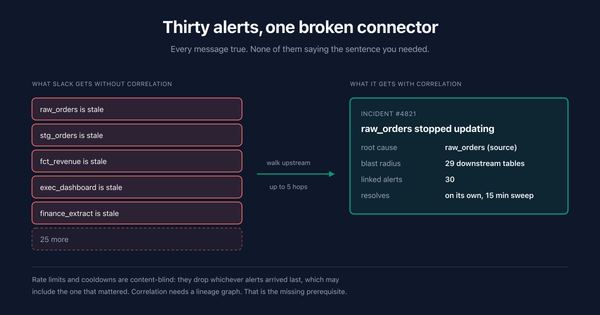
It varies, and it's worth testing. The stronger ones do real correlation and root-cause work across sources. The weaker ones summarize alerts you could already see. The test is whether the agent tells you something you didn't already know from the alert, and whether it shows the evidence.
Can I run a data quality agent without replacing my current stack?
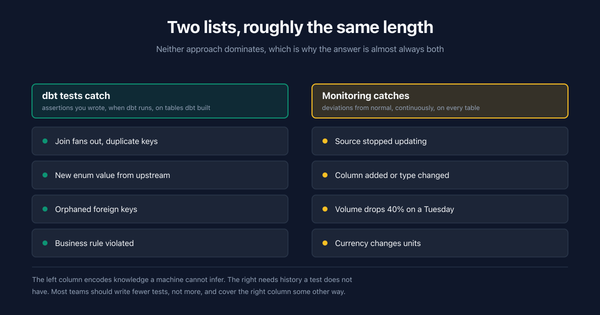
Usually yes. Most agents, native or bolted-on, work off warehouse metadata and sit alongside your existing dbt tests and pipelines. You don't have to rip anything out to try one.
Is agent-native less capable than the big platforms?
On raw breadth of connectors and enterprise controls, the incumbents are ahead, and it's fair to say so. On verifiability and time-to-value for a normal-sized team, the native tools are often better. Match the choice to your scale.
What about false positives?
Every agent risks over-flagging, regardless of camp. Evaluate whether it learns per-table baselines and whether you can tune sensitivity. That matters more than which logo is on it.
AnomalyArmor is an agent-native data quality tool for Snowflake and Databricks, priced at $5 per table and currently in private beta. If you want an agent whose findings you can actually verify, reach out and we'll get you access.