What Is the Best Anomalo Alternative in 2026?
Anomalo's unsupervised ML is the real thing. Ask what it costs, what it explains, and whether you have the history to feed it.
Anomalo is an enterprise data quality platform built on unsupervised machine learning, which learns what normal looks like for each table and flags deviations without you writing rules or thresholds. It has raised $121M, counts Snowflake Ventures among its investors, and sells to large enterprises.
We compete with them at the small end and lose at the large end, which is a reasonable summary of this whole post. What follows is where each of us actually fits, and the two questions I would ask Anomalo if I were buying.
What is Anomalo's actual differentiator?
Unsupervised anomaly detection applied broadly, and it is genuinely more sophisticated than most of the category.
The pitch is that you point it at a table and it learns the table's normal behaviour without configuration. It goes past row counts and freshness, which everyone does, into the distributions of individual columns, the relationships between them, and the subtle shifts a threshold-based check would never catch. Their own framing distinguishes the "loud" anomalies everyone notices from the "silent" shifts most tools miss, and that distinction is the right one.
They extended this into unstructured data, generally available since May 2025, using LLMs to assess text content against standards like relevance, completeness, bias, and toxicity. If you are feeding a document corpus into a RAG pipeline and want to know whether the corpus is degrading, very few tools address that at all.
The Snowflake relationship is real rather than a logo. Snowflake Ventures invested in March 2025, Anomalo integrates Snowflake's Data Metric Functions and Cortex AI, and the platform ships as a containerized Native App on the Snowflake Marketplace, so customer data stays inside the customer's Snowflake environment. As of late 2024, over 60% of Anomalo's customers were on Snowflake.
That last point matters for a specific buyer: if your security review treats "data leaves our warehouse" as a blocker, a Native App that runs inside your account is a meaningfully different proposition from a vendor connecting in.
What does a silent failure actually look like?
The case for deep ML rests entirely on this class of problem, so it is worth making concrete rather than leaving as a category.
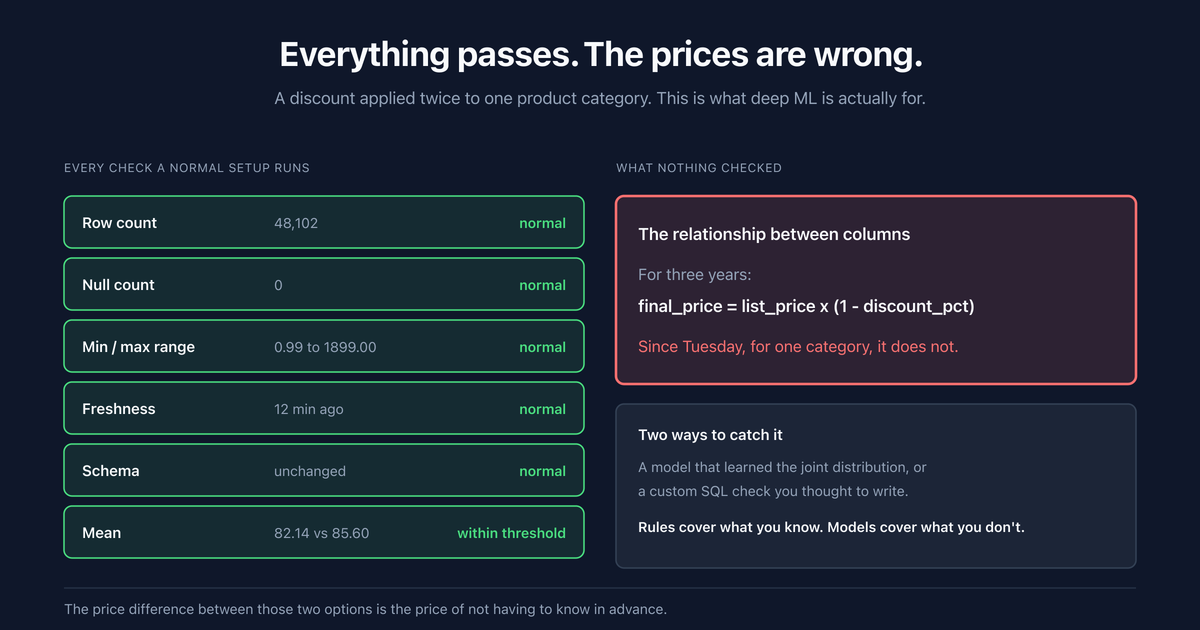
Here is one that no threshold catches. A pricing table has list_price and discount_pct, and for three years final_price has been consistently list_price * (1 - discount_pct). An upstream change starts applying the discount twice for one product category.
Run the checks a normal monitoring setup would have:
-- Row count: unchanged
SELECT COUNT(*) FROM prices;                          -- 48,102, normal

-- Nulls: unchanged
SELECT COUNT(*) FROM prices WHERE final_price IS NULL; -- 0, normal

-- Range: still plausible
SELECT MIN(final_price), MAX(final_price) FROM prices; -- 0.99, 1899.00, normal

-- Mean: moved 4%, inside any sane threshold
SELECT AVG(final_price) FROM prices;                   -- 82.14 vs 85.60 last month
Everything passes. Freshness is fine, the schema is unchanged, no rule fires, and one category of products is priced wrong.
What would catch it is a model that learned the relationship between those three columns and noticed it stopped holding. That is the thing unsupervised ML across a feature space does and a per-metric forecast does not. I want to be straightforward: we would not catch this, and Anomalo plausibly would.
The honest counterweight is how often this happens relative to a Fivetran connector dying. In my experience the ratio is not close, and a team that has never diagnosed a failure of this kind is buying against a risk they have not yet observed. But if you have found one of these the hard way, you now know why the enterprise tools cost what they do.
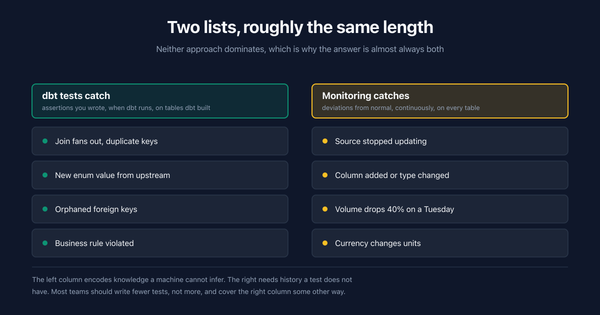
The middle path worth knowing: you can encode a known relationship as an explicit check without any ML at all.
-- A custom SQL check any tool can run
SELECT COUNT(*) FROM prices
WHERE ABS(final_price - list_price * (1 - discount_pct)) > 0.01;
That catches this specific invariant, costs nothing, and requires you to have thought of it. Which is the recurring trade in this whole category: rules cover what you know, models cover what you don't, and the price difference between them is the price of not having to know.
What does Anomalo cost?
Not published. Enterprise pricing, quoted, with entry-level tiers described in terms of thousands of tables per year.
I can't give you a number honestly and I'd distrust anyone in my position who claimed to. What I can characterize is the shape: it is a sales-led enterprise motion, priced for organizations with thousands of tables and a procurement process, and there is no self-serve path.
That shape has consequences beyond the invoice:
- Evaluation costs weeks. Demo, security review, pilot, negotiation. If you need monitoring running on Thursday, this is not the path.
- The floor is high. Enterprise contracts have minimums. A team with 80 tables is not the customer, and being sold to anyway is how people end up paying enterprise rates for a fraction of the product.
- You will not know if you overpaid. Quoted pricing means your rate is a function of your negotiating position.
| Tool | Pricing | Self-serve | Buyer |
|---|---|---|---|
| Anomalo | Enterprise, quoted | No | Large enterprise |
| Monte Carlo | Enterprise, quoted | No | Large enterprise |
| Bigeye | Enterprise, quoted | No | Mid to large |
| Elementary Cloud | Seats plus tables, quoted | Trial | Mid |
| Soda | $0 Free, $750/mo Team plus usage | Yes | Small to mid |
| AnomalyArmor | $5/table/month | Yes | Small to mid |
The pattern across this category is that ML depth and price track together, and both track with how little the vendor tells you before a call. That is not a criticism, it is a market segmentation, and the useful thing is to know which segment you are in before you take the meeting.
How do you size the decision?
The cleanest way to cut this is table count crossed with what kind of failure you actually get, because those two together predict the right answer better than any feature grid.
| Your situation | Sensible choice | Why |
|---|---|---|
| Under 100 tables, freshness and schema failures | Self-serve monitoring | Enterprise minimums make no sense at this size |
| 100 to 500 tables, mostly pipeline failures | Self-serve or mid-market | ML depth is not your constraint |
| 500+ tables, dedicated data quality headcount | Anomalo, Monte Carlo, Bigeye | You have the volume and the people to run it |
| Any size, documented silent failures | Anomalo, Monte Carlo, Bigeye | This is the failure class they are built for |
| Any size, unstructured data in an AI pipeline | Anomalo | Few real competitors here |
| Any size, security blocks vendor connections | Anomalo Native App, or self-hosted OSS | Data stays in your environment |
The row that trips people is the fourth. "Documented" is doing real work there. It means you can name a specific incident where the data was wrong, nothing alerted, and a distribution shift was the cause. Not a suspicion that it might be happening, an incident you diagnosed.
That distinction matters because unsupervised ML is the most expensive capability in this category and the hardest to evaluate in a 30-day pilot. Silent failures are, by construction, rare and hard to reproduce on demand. So a pilot mostly shows you how the tool handles the loud failures every tool handles, and you end up buying the expensive part on faith.
If you are in that position, the useful pilot design is backwards-looking: give the vendor 6 months of history for a table you know had a silent problem, and ask whether their model flags the window where it happened. That is a real test. "Point it at production for 30 days" is not, because 30 quiet days prove nothing about a capability that exists for the 31st.
What are the real alternatives?
Depends which of Anomalo's properties you are actually buying.
If you want the ML depth, your alternatives are Monte Carlo and Bigeye, both of which are also enterprise-quoted. There is no cheap version of a large ML investment, and anyone offering one is describing a z-score.
If you want broad automatic coverage without the enterprise motion, that is where we sit and where Elementary Cloud sits. Less sophisticated detection, published or lighter pricing, self-serve. I'll be specific about the gap in a moment.
If you want checks you control explicitly, Soda or Great Expectations, which is a different philosophy entirely and covered in the Soda comparison and the Great Expectations one.
If you want unstructured data monitoring, Anomalo is genuinely ahead. I am not aware of a close alternative at comparable maturity, and we do not do it at all.
How does the detection actually differ?
This is the part worth being precise about rather than hand-waving, because "AI-powered" is now on every homepage in the category including ours.
Ours is a forecast model with a fallback. We use Prophet-based forecasting with seasonality detection, falling back to a standard deviation threshold when there are fewer than 14 historical data points. Sensitivity is a confidence interval mapped to a z-score: 0.95 gives you 1.96, 0.99 gives 2.58, 0.80 gives 1.28. Every verdict comes back with the method that produced it, the expected value, and the expected range.
That is a legitimate approach and it is not the same thing as unsupervised ML across a table's full feature space. A forecast on a single metric catches that a metric moved. Learning a table's joint distribution catches that two columns that always moved together stopped doing so, which is a class of problem we do not detect.
If your failures are of the second kind, pay for the deeper tool. I would rather say that than pretend the difference is marketing.
What I would push back on is the assumption that deeper detection is automatically the constraint. Two honest questions for any ML-heavy vendor:
How much history does it need? Unsupervised models need volume to learn from. On a table with 90 days of history and daily granularity, sophisticated models and simple ones converge, because neither has much to work with. Ask what the cold-start behaviour is and what it does for the first month.
What does it tell you when it fires? This is the one I care about most. A finding that says "an anomaly was detected in this table" with high confidence and no traceable reasoning is difficult to act on and impossible to verify. The whole argument in how do you know your data quality agent is right applies here: ask what you can click on, and ask what the confidence number is actually measuring.
Those questions are fair to ask us too, and our answer is that the detection is shallower and the explanation is traceable. Different bet.
Who should not buy Anomalo?
Four situations, and I mean these as genuine guidance rather than positioning.
You have fewer than a few hundred tables. Enterprise minimums make the per-table economics bad, and the ML advantage is smallest exactly where data volume is smallest.
You need it running this week. There is no self-serve path. If the trigger for this search was an incident and you need coverage immediately, buy something you can turn on and evaluate the enterprise option properly later.
Your problems are freshness and schema changes. These are the majority of real incidents and they do not require sophisticated ML. A freshness monitor is a timestamp comparison. If your last three incidents were a broken connector and two column renames, you are considering a solution to a different problem.
You cannot articulate what "silent" failure you are missing. The strongest case for deep ML is a specific class of failure you know is getting through. If you cannot name one, you are buying capability rather than solving a problem, and capability you cannot articulate is capability you will not configure.
One caveat on the third point, since it reads as more dismissive than I mean it. Freshness and schema monitoring being sufficient is a statement about the incidents you have observed, and you only observe the ones something told you about. A team whose monitoring only covers freshness will report that its incidents are freshness incidents, which is a measurement artifact rather than a finding. The way out is not to buy the most expensive tool defensively; it is to check a few tables you care about against their own history and see whether anything looks wrong that nobody ever alerted on.
Conversely, if you have thousands of tables, an actual data quality function with headcount, unstructured data in an AI pipeline, and a Snowflake-centric stack with a security posture that favours a Native App, Anomalo is a strong fit and I would not try to talk you out of it.
What should you test in an evaluation?
Four tests, which apply to us equally.
- Point it at your ugliest table. Not the clean fact table. The one with inconsistent nulls, seasonal volume, and a column somebody renamed. Every tool looks good on
dim_date. - Ask what happens in week one. Unsupervised models need history. Find out what it does before it has any, because that is when you will be forming your opinion of the product.
- Break something and read the output. Drop a column in a staging copy, change a unit, stall an ingestion job. Then judge the alert on whether a person could act on it without further investigation.
- Ask for the config export. If your monitoring definitions cannot leave in a format another tool reads, the switching cost compounds every quarter. This is the question the whole category has gotten worse at answering, and it is the one I would put first in a consolidating market.
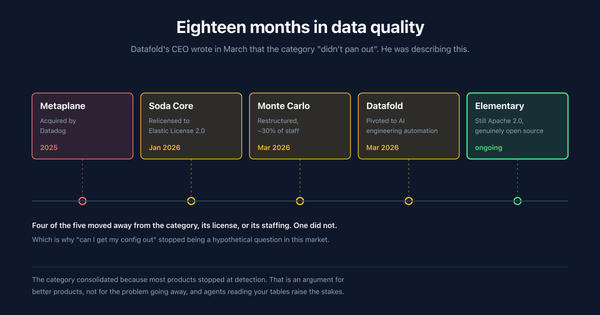
That last point is why our config exports as ODCS YAML with a documented command. Not as a feature, but because "can I leave" stopped being hypothetical in a year when Metaplane was absorbed into Datadog, Monte Carlo restructured, Datafold pivoted, and Soda Core relicensed.
Frequently asked questions
What is the best Anomalo alternative in 2026?
Monte Carlo or Bigeye if you want comparable ML depth at enterprise scale. AnomalyArmor or Elementary Cloud if you want automatic coverage without an enterprise sales cycle. Soda or Great Expectations if you would rather write explicit checks.
How much does Anomalo cost?
It is not published. Anomalo sells an enterprise, quoted contract with entry tiers described in thousands of tables per year, and there is no self-serve signup.
What makes Anomalo different from other data quality tools?
Unsupervised machine learning applied across a table's full feature space rather than a set of predefined checks, plus unstructured data monitoring that uses LLMs to assess text content. It is deeper detection than most of the category.
Is Anomalo worth it for a small data team?
Usually not. Enterprise minimums make the per-table economics poor below a few hundred tables, and the ML advantage is smallest exactly where you have the least history for a model to learn from.
Does Anomalo run inside Snowflake?
It is available on the Snowflake Marketplace as a containerized Native App, so monitoring can run inside your own Snowflake environment. Snowflake Ventures invested in Anomalo in March 2025, and the integration includes Data Metric Functions and Cortex AI.
Do I need unsupervised ML for data quality?
Only if your failures are the kind simpler methods miss. Freshness breaks, schema changes, and volume drops are the majority of real incidents and none of them need sophisticated modelling. Deep ML earns its cost on silent distribution shifts.
What is a silent data quality failure?
One where nothing breaks and no rule fires, but the data changed meaning. A currency field switching from dollars to cents, a column's distribution shifting because an upstream filter changed, two correlated columns decoupling. Everything passes and the numbers are wrong.
How much history does anomaly detection need?
More than most people expect. Models learning a table's normal behaviour need enough observations to distinguish signal from noise, so a table with 90 days of daily granularity offers little for a sophisticated model to work with. Ask every vendor about cold-start behaviour.
Can Anomalo monitor unstructured data?
Yes, generally available since May 2025, using LLMs to assess content against standards like relevance, completeness, bias, and toxicity. If you are running a RAG pipeline over a document corpus, few competitors address this at all.
What should I ask an ML-heavy vendor?
How much history the model needs and what it does before it has that. What the alert tells you beyond the fact that something is anomalous. What the confidence number measures. And how to get your configuration out.
Is AnomalyArmor's detection as sophisticated as Anomalo's?
No. Ours is Prophet-based forecasting with seasonality detection and a standard deviation fallback below 14 data points, per metric. That catches a metric moving; it does not catch two columns that always moved together decoupling. If that class of failure is your problem, buy the deeper tool.
How do I pilot an ML-based data quality tool properly?
Backwards, not forwards. Give the vendor several months of history for a table you know had a silent problem, and check whether their model flags that window. Thirty quiet days in production prove nothing about a capability that exists for the day something subtle goes wrong.
Can I catch relationship failures without ML?
Yes, if you know the relationship. A custom SQL check asserting final_price = list_price * (1 - discount_pct) catches that specific invariant for free. The limitation is the obvious one: it only covers invariants you thought to write down.
Why does portable config matter when comparing vendors?
Because this category is consolidating and your config is the switching cost. Metaplane went to Datadog, Monte Carlo restructured, Datafold pivoted, and Soda Core relicensed, all within about eighteen months. Ask for the export command and run it before you sign.