What Is the Best Great Expectations Alternative in 2026?
Great Expectations is free to install and expensive to maintain. What the alternatives change, and how to port your suites without losing them.
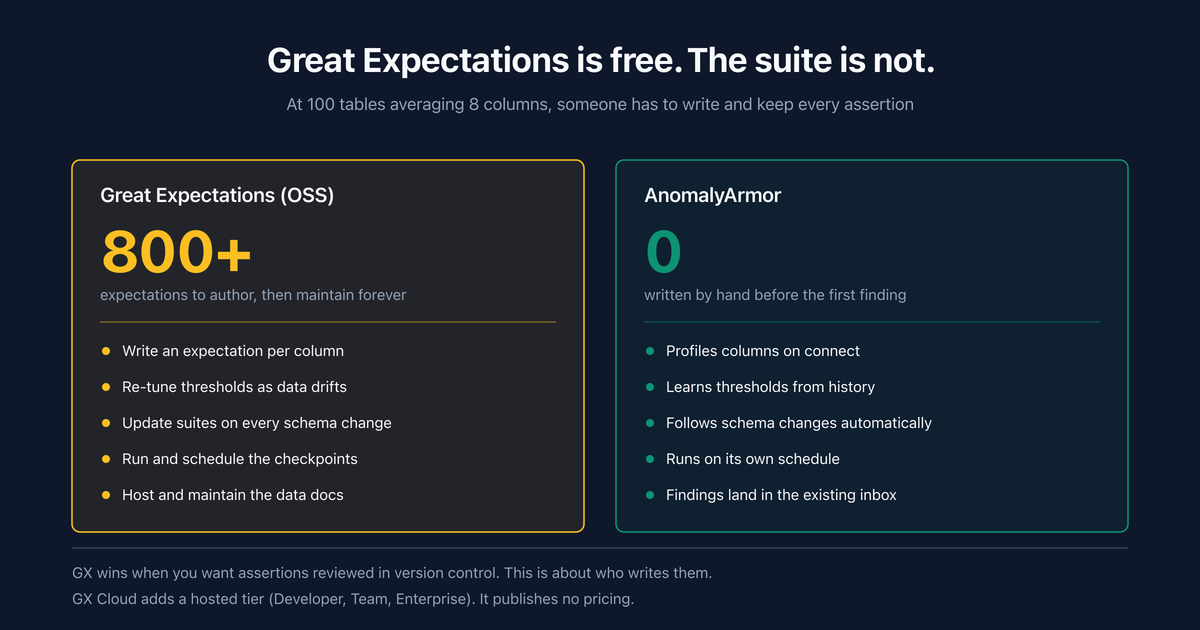
A Great Expectations alternative is a data quality tool that replaces hand-authored expectation suites with monitors derived from the data itself. The distinction matters because Great Expectations is free to install and costly to keep, and the cost lives in engineering time rather than a line item.
I want to be straight about something before going further. Great Expectations is good software. The project popularized the idea that data deserves assertions the way code deserves tests, and the ODCS-style thinking that a lot of us now take for granted owes it a debt. If you want your data assertions reviewed in a pull request, versioned next to the models they guard, and executed in CI, GX is the right tool and nothing here changes that.
The problem shows up later, and it always shows up the same way.
Why do teams look for a Great Expectations alternative?
Nobody churns off GX in week one. Week one is great. You install it, point it at a table, write a handful of expectations, and watch them pass. The demo works.
The trouble starts around month six, when you have a hundred tables instead of one.
Do the arithmetic on a mid-size warehouse. A hundred monitored tables averaging eight columns is eight hundred columns. If you write even one expectation per column, which is the bare minimum anyone would call coverage, you are authoring and then maintaining eight hundred assertions. That number is not the hard part. The hard part is that it is not a number at all, it is a rate. Every new table adds to it. Every schema change invalidates some of it. Every threshold you set by hand drifts out of date as the data changes underneath it.
Four specific things go wrong, and they compound:
Suite maintenance outruns suite authoring. Writing expect_column_values_to_be_between("amount", 0, 10000) takes a minute. Discovering eight months later that legitimate order values now exceed ten thousand, tracking down which suite that lives in, and updating it takes an afternoon and usually starts with a false alert at 2am.
Coverage stalls where attention stopped. The tables someone cared about in Q1 have expectations. The tables that appeared in Q3 have none. There is no mechanism that notices this, because the mechanism is a person remembering.
Thresholds are guesses that age. A hand-set bound encodes what you believed about the data on the day you wrote it. Data changes. The bound does not.
The runner is your problem. Checkpoints need scheduling. Data docs need hosting. Something has to alert when a suite fails, and by default that something is an exit code.
None of this is a defect in GX. It is what a library does. A library gives you the primitive and leaves the operations to you. The question is whether you want to run that operation.
What does eight hundred expectations cost in engineering time?
Free software with a large time cost is still a cost, so put a number on it.
Assume a loaded engineering cost of $80 to $150 per hour, which is the usual range for a mid-level data engineer in the US once benefits and overhead are counted. Now assume authoring an expectation takes five minutes on average. Some take thirty seconds, some take an hour because you had to go ask what the column means.
Eight hundred expectations at five minutes each is about 67 hours, so roughly $5,400 to $10,000 of engineering time to reach baseline coverage once.
The one-time number is the small one. Maintenance is the real line item. In practice teams spend somewhere between two and eight hours a month per hundred tables on suite upkeep: chasing false alerts from thresholds that drifted, updating suites after schema changes, and adding coverage for new tables. Call it four hours a month at 100 tables. That is 48 hours a year, another $3,800 to $7,200 annually, and it recurs.
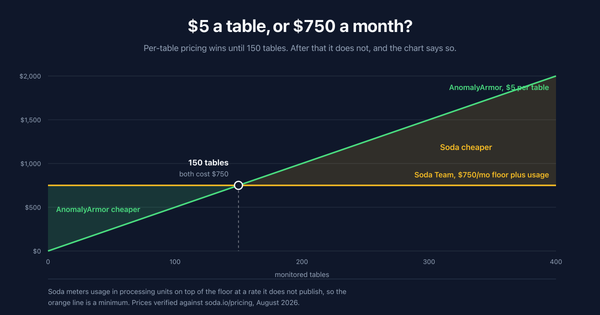
Compare that against a published per-table price. A hundred tables at $5 per table per month is $6,000 a year, and nobody on your team spends an afternoon on threshold drift. The comparison people make is "free versus $6,000." The comparison worth making is "$6,000 versus roughly $9,000 of engineering time that could have gone to the pipeline instead."
Two honest caveats on that math. The five-minute figure is my estimate from watching teams do this, not a benchmark, and your maintenance hours depend heavily on how volatile your schemas are. If your warehouse barely changes, GX maintenance is close to free and you should stay. If you ship schema changes weekly, the number is worse than I've written.
What is GX Cloud, and does it solve this?
Great Expectations the company ships a hosted product, GX Cloud, with Developer, Team, and Enterprise tiers. It handles the runner, the scheduling, and the UI, which removes the operational half of the problem.
It does not remove the authoring half. You still describe what "correct" means, expectation by expectation. Hosted execution is a real convenience and it is not the same thing as not writing the suite.
One practical note for anyone evaluating: GX Cloud publishes no pricing on any tier. You will be talking to a salesperson to find out what it costs. That is a common pattern in this category and worth naming, since the reason many people run open-source GX in the first place is that they did not want that conversation. We take the opposite position and publish a per-table number, for the same reason we published our full cost breakdown of the category: if a vendor will not tell you the price before a call, the price is a negotiation and you are the variable.
What should a Great Expectations alternative actually do differently?
Here is the test I would apply, and it has nothing to do with feature checklists. Ask how many assertions you have to write before the tool finds its first real problem.
For GX, the answer is however many you author. For a monitoring platform that profiles your data, the answer should be zero, because the tool has already looked at the table and knows what normal looks like.
That single question sorts the category faster than any comparison grid:
| Capability | Great Expectations (OSS) | GX Cloud | AnomalyArmor |
|---|---|---|---|
| Assertions before first finding | However many you write | However many you write | 0 |
| Threshold source | Hand-set | Hand-set | Learned from history |
| New table appears | Unmonitored until authored | Unmonitored until authored | Profiled and monitored |
| Schema change | Suite breaks or silently passes | Suite breaks or silently passes | Detected and reported |
| Runner and scheduling | You host it | Hosted | Hosted |
| Assertions in version control | Yes, native | Partly | Yes, via ODCS contracts |
| Published price | Free | None published | $5 per table per month |
That version-control row is the one people assume they have to give up, and they don't. More on that below, because it is the thing that actually blocks migrations.
How do you migrate off Great Expectations without losing the suites?
This is the real objection, and it is a good one. You have spent a year encoding domain knowledge into expectation suites. "Rip it out and let the AI figure it out" is not a migration plan, it is a request to throw away work.
So we wrote the converter. armor migrate-from great-expectations reads a GX project on disk and emits an ODCS YAML contract:
armor migrate-from great-expectations ./great_expectations/ \
  | armor contract apply --asset <asset-uuid> -f -
The adapter is file-based. It reads great_expectations.yml and the expectation-suite JSON directly, so you do not need the great_expectations package installed to run it. It auto-detects legacy projects and v1 projects using Fluent Datasources.
Two expectations land on native ODCS fields, which means they round-trip through any ODCS-compatible tool rather than being locked to us:
| Great Expectations | ODCS field |
|---|---|
expect_column_values_to_not_be_null |
schema[].properties[].required = true |
expect_column_values_to_be_unique |
schema[].properties[].unique = true |
Five more map to validity rules under customProperties.anomalyarmor.validity:
| Great Expectations | Rule type | Translation |
|---|---|---|
expect_column_values_to_be_in_set |
allowed_values |
value_set to values |
expect_column_values_to_match_regex |
regex_match |
regex to pattern |
expect_column_values_to_be_between |
range_bounds |
min_value / max_value to min / max |
expect_column_value_lengths_to_be_between |
length_bounds |
to min_length / max_length |
expect_column_values_to_match_strftime_format |
format |
%Y-%m-%d to iso_date |
What the converter cannot translate
I would rather tell you this up front than have you discover it mid-migration. These do not convert, and the command reports them as warnings in the summary instead of dropping them silently:
expect_column_pair_*andexpect_multicolumn_*, because cross-column logic has no clean single-property homeexpect_column_kl_divergence_*and other statistical distribution checks- Custom expectations, including
dbt_expectations.*and any user-defined subclass expect_column_values_to_be_of_type, because type-system translation is genuinely its own problem- Table-scoped expectations like
expect_table_row_count_to_be_between
For those, write a custom SQL check after the migration rather than forcing them through a shape that does not fit. A converter that pretended to handle multicolumn logic would be worse than one that tells you it can't.
If your suites live in a database or S3 rather than on disk, export them first:
import great_expectations as gx

context = gx.get_context()
for name in context.list_expectation_suite_names():
    suite = context.get_expectation_suite(name)
    with open(f"expectations/{name}.json", "w") as f:
        f.write(suite.to_json_dict())
The output is an open standard, not our proprietary format. If you leave us in a year, the contract comes with you. That is deliberate, and it is the same reasoning behind open-sourcing our query layer.
Do you lose assertions-as-code by moving off GX?
No, and this is the misconception worth killing.
The choice is usually framed as explicit assertions in git versus a black box that decides for you. That framing is wrong because the two are not mutually exclusive. ODCS contracts are YAML. They live in your repo, they diff in a pull request, and they apply through a CLI you can run in CI.
What changes is what you have to write by hand. Automatic monitoring covers the broad, boring surface: freshness, volume, null rates, distribution shifts, schema changes. Contracts cover the specific domain rules that a profiler could never infer, like "status is one of these five values" or "this identifier matches this regex."
You should be writing the second kind. You should not be hand-writing the first kind for eight hundred columns.
Where does dbt fit?
If your assertions live in dbt tests rather than GX, most of this still applies, with one extra wrinkle: dbt tests fail in ways that don't look like failures. A test with severity: warn fails and still exits zero. A test that only runs in CI never protects production. We covered the five patterns in detail in silent dbt test failures, and the short version is that a green dbt build is weaker evidence than most teams treat it as.
The GX-versus-dbt-tests question is mostly a preference about where assertions live. Neither one profiles your data or notices a table nobody wrote a test for.
How does this compare to the commercial platforms?
If you are evaluating GX alternatives you are probably also looking at the managed observability vendors. Short version, with the caveat that I run one of these companies and you should discount accordingly:
- Monte Carlo is the enterprise incumbent, priced accordingly, and sells to a data platform team with a budget line. See the detailed comparison.
- Metaplane, now part of Datadog, is the natural fit if you are already deep in Datadog. Comparison here.
- Bigeye sits in the enterprise tier with custom quotes. Comparison here.
- Soda splits open-source and commercial, with SodaCL as a contract language, which puts it closer to GX philosophically than to the auto-profiling tools.
The honest summary: for a team coming off open-source GX, the deciding factor is rarely the detection algorithms. Those converge. It is whether you can get a price without a sales call and whether the tool covers the tables you forgot about.
How do you run a fair bake-off?
Vendor evaluations in this category usually get decided by demo quality, which measures the vendor's sales engineer rather than the tool. Here is a four-week test that measures the tool instead. Run it against your own warehouse, because a demo dataset is chosen to make detection look easy.
Week 1: baseline in silence. Connect the candidate tool to a real schema and change nothing else. Keep GX running. Do not tune anything, do not create rules. You are measuring what the tool finds with zero configuration, which is the whole claim under test.
Week 2: count the disagreements. Build three lists. Things GX caught that the tool missed. Things the tool caught that GX missed. Things both caught. That third list is the least interesting and it is where most evaluations stop.
Week 3: judge the second list honestly. For every finding the tool surfaced that your suites missed, ask whether it was real and whether you would have wanted to know. A finding that is technically correct and operationally irrelevant is noise, and noise is what kills these tools six months in. Count precision, not volume. A tool that surfaces 40 findings of which 6 matter is worse than one that surfaces 8 of which 6 matter.
Week 4: break something on purpose. Rename a column in a staging table. Delay a load by six hours. Insert a batch of nulls into a column that has never had them. Time how long each system takes to tell you, and note which one tells you what broke downstream rather than only that something broke.
The number that decides it is not detection rate. It is findings per week that changed what someone did. Track that for four weeks and the decision usually makes itself, in whichever direction.
One thing to hold constant: run both against production data, not a sample. Profiling-based tools learn from history, so a tool pointed at two weeks of backfilled test data will underperform what it does against a real table with real seasonality.
Choosing: a short decision rule
Stay on Great Expectations if your assertions are the point. Regulated reporting, contractual data guarantees, and anything where you need to show an auditor the specific rule and its commit history. GX is built for that and does it well.
Move if coverage is the point. If you cannot name every table in your warehouse from memory, and if new tables appear faster than someone writes suites for them, you are running a race you lose slowly.
Most teams need both, which is why the migration path exists rather than a replacement pitch.
Frequently asked questions
Is Great Expectations still maintained in 2026?
Yes. The project is active and GX Cloud is the company's commercial offering. Choosing an alternative is a decision about operating model, not about abandonment risk.
What does Great Expectations cost?
The open-source library is free. The cost is engineering time to author and maintain suites, plus hosting the runner and data docs. GX Cloud has Developer, Team, and Enterprise tiers, and publishes no pricing for any of them.
How many expectations does a typical warehouse need?
At one expectation per column, a hundred tables averaging eight columns is eight hundred. Real suites usually run several per column on important tables, so the practical number is higher. The count grows with your warehouse whether or not anyone is writing them.
Can I convert my expectation suites automatically?
Partly. armor migrate-from great-expectations converts seven common expectation types into ODCS contract fields and validity rules. Cross-column, statistical, custom, type, and table-scoped expectations are reported as warnings and need manual handling.
Do I need Great Expectations installed to run the migration?
No. The adapter reads great_expectations.yml and the suite JSON files from disk. If your suites live in a non-default store, export them to expectations/ first.
Does the migration support GX v1 projects?
Yes. The adapter auto-detects legacy projects and v1 projects using Fluent Datasources, and pulls per-column type hints from the fluent_datasources block into physicalType.
Will I lose my assertions in version control?
No. The output is ODCS YAML, an open standard. It lives in your repo, diffs in review, and applies through the CLI in CI.
What happens to custom expectations like dbt_expectations?
They surface as warnings in the migration summary rather than being silently dropped. Rewrite them as custom SQL checks after migrating.
Is ODCS a proprietary format?
No. The Open Data Contract Standard is a public specification. Contracts written against it work with other ODCS tooling, which is the point of using it instead of inventing our own YAML.
What is the difference between data testing and data monitoring?
Testing asserts what you already know should be true. Monitoring detects what you did not think to assert. Suites are testing, profiling is monitoring, and most teams discover they needed the second one during an incident.
Does automatic monitoring replace domain rules?
No. Profiling cannot infer that status must be one of five values or that an identifier follows a particular regex. Write those as contracts. Do not hand-write freshness and null-rate checks for every column.
How long does a migration take?
The conversion itself is one command. The real work is triaging the warnings for expectations that did not map, which scales with how many custom and cross-column expectations you wrote.
Can I run both during a transition?
Yes, and you should. Keep GX running in CI while monitoring runs against production, compare what each catches for a few weeks, and decide with evidence instead of a migration-day cutover.
What about schema changes breaking my suites?
That is the failure mode worth planning for. A renamed column breaks a suite loudly, which is fine. A new column arrives with no expectation at all, which is the silent case. We wrote up how to monitor schema changes separately.