What Is the Best Metaplane Alternative in 2026?
Metaplane is now Metaplane by Datadog. If you picked it to stay off an enterprise observability platform, the acquisition changes the math. An honest comparison with AnomalyArmor: pricing, features, the Datadog question, and when each is the right call.
A Metaplane alternative is a data observability tool that monitors warehouse tables for freshness, volume, schema, and distribution issues, the same job Metaplane does, without Metaplane's per-table pricing or its new ownership by Datadog. The most common reasons teams look for one in 2026 are the $10 per-table cost and the April 2025 Datadog acquisition that turned Metaplane into "Metaplane by Datadog."
I built AnomalyArmor, so treat this as a biased source and verify the numbers yourself. The links to Metaplane's own pricing and Datadog's acquisition announcement are below so you can. What follows is the comparison I would want if I were the one evaluating: where Metaplane is genuinely good, where the acquisition introduces risk, and where a cheaper standalone tool makes more sense.
Why are data teams looking for a Metaplane alternative now?
Two things changed in 2025 and 2026.
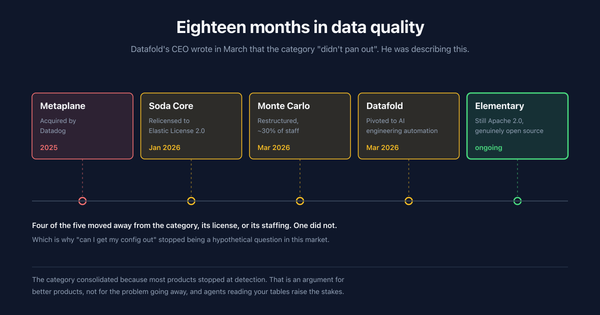
First, Datadog acquired Metaplane in April 2025. Metaplane now operates as "Metaplane by Datadog." Datadog has stated existing contracts will be honored with at least three months of notice for changes, and that it will reach out to every Metaplane customer. That outreach is the part worth thinking about. If you chose Metaplane because you specifically did not want to be inside a large, consumption-priced observability platform, the acquisition moved the product toward exactly that.
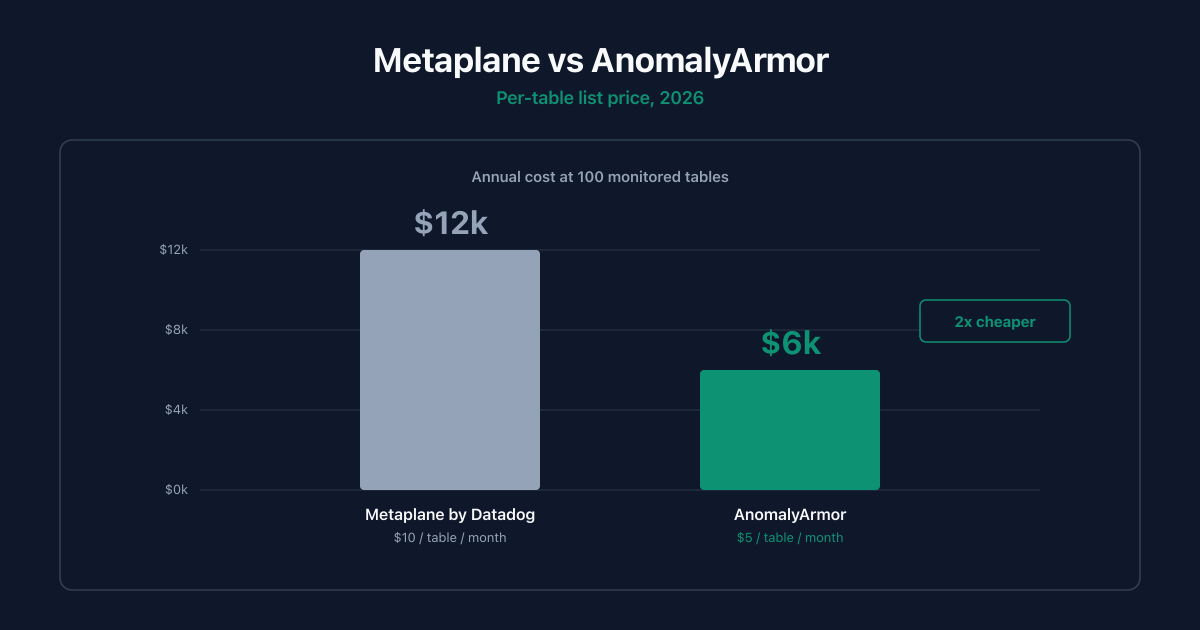
Second, the per-table cost adds up. Metaplane's Pro plan is $10 per monitored table per month, billed on tables with monitors running more than 30 days. At 100 tables that is $1,000 per month, or $12,000 per year, before any negotiation. For a mid-sized warehouse the table count climbs fast once you monitor staging and mart layers.
| Trigger | Change | Buyer concern |
|---|---|---|
| Datadog acquisition | Now "Metaplane by Datadog" | Cross-sell pressure, renewal pricing |
| Per-table list price | $10/table/month Pro plan | Cost scales with table count |
| Category consolidation | Several tools acquired in 2025-26 | Vendor independence at risk |
How much does Metaplane cost compared to AnomalyArmor?
Metaplane's published Pro pricing is $10 per table per month. AnomalyArmor is $5 per table per month. Both bill on monitored tables, so the comparison is direct.
| Tables monitored | Metaplane (Pro, $10/table/mo) | AnomalyArmor ($5/table/mo) | Annual difference |
|---|---|---|---|
| 50 | $6,000/yr | $3,000/yr | $3,000 |
| 100 | $12,000/yr | $6,000/yr | $6,000 |
| 250 | $30,000/yr | $15,000/yr | $15,000 |
| 500 | $60,000/yr | $30,000/yr | $30,000 |
A note on discounting, because the table only shows list. Metaplane does offer volume and enterprise discounts at scale: larger table counts and multi-year commitments routinely land below the $10 list rate, sometimes meaningfully so. Your negotiated number is the one that matters, especially at 250-plus tables, and it's the question to take into renewal. AnomalyArmor's $5 list is the same for everyone, no negotiation required to learn the price; the comparison above is list-to-list. The structural point holds regardless of discount: a standalone tool priced at half the per-table rate compounds in your favor as the warehouse grows, and it's the rate you can see before any conversation.
What does Metaplane do well?
A fair comparison names what the competitor is good at. Metaplane earned its customer base, and the case-study list on its site is real.
- Column-level lineage. Metaplane's lineage graph is mature and one of the better implementations in the category. If lineage visualization is your primary buying criterion, evaluate it seriously.
- Polished UX. The product is well-designed and the onboarding is smooth. This is not a rough tool.
- Integration breadth. Snowflake, Databricks, BigQuery, Redshift, dbt, Slack, PagerDuty, and the rest of the expected stack are all covered.
- ML-based anomaly detection. Metaplane's baseline learning for volume and freshness anomalies is solid and well-documented.
- Datadog backing, if you want it. If your organization is already a heavy Datadog shop, the acquisition is a feature, not a risk. Unified billing and a single observability vendor is a legitimate preference.
If those map to your situation, Metaplane is a defensible choice and you should weigh the acquisition as neutral or positive.
What does AnomalyArmor do that Metaplane does not?
AnomalyArmor covers the same monitoring core: schema drift, freshness, volume, distribution, custom SQL checks, Slack and PagerDuty alerts, dbt integration, and lineage. The differences are these:
- Half the per-table price. $5 versus $10, with no per-source surcharge.
- AI-native question answering. You can ask, in natural language, "which tables feed the revenue dashboard and have any of them changed this week," and get an answer grounded in your actual metadata. This is built in, not a roadmap item.
- Works from inside your AI assistant. AnomalyArmor ships an MCP server and a skill pack, so you can set up and query monitoring from Claude Code, Cursor, or your agent of choice without opening a separate UI. Most observability tools, Metaplane included, assume you live in their dashboard.
- Standalone and staying that way. AnomalyArmor is not part of a larger consumption-priced platform and is not being cross-sold into one.
The acquisition question: does it actually matter?
It depends entirely on what you wanted Metaplane to be.
If you bought Metaplane because it was a focused, independent, mid-market data observability tool, the acquisition moved it away from that. Datadog is a large, consumption-priced platform with a sales motion built around expansion. Metaplane has committed to honoring contracts and giving three months of notice, which is reasonable, but the medium-term direction of any acquired product is set by the acquirer's incentives, not the original team's.
If you are already a Datadog customer, the same facts read as an advantage: one vendor, one bill, one support relationship.
Here is a decision framework. I call it the Acquisition Fit Test. Score each statement true or false:
- We are already a significant Datadog customer.
- We prefer one observability vendor across infrastructure, apps, and data.
- We are comfortable with consumption-based pricing that scales with usage.
- Our Metaplane contract renewal is more than 12 months away.
Three or four "true" answers: the acquisition is low risk for you, and Metaplane remains a reasonable choice. Zero, one, or two "true": you chose Metaplane for reasons the acquisition undercuts, and evaluating a standalone alternative before renewal is rational.
How do you migrate from Metaplane to AnomalyArmor?
The migration is mechanical, not a rebuild, because both tools monitor the same warehouse objects.
- Connect the warehouse. Read-only credentials to Snowflake, Databricks, BigQuery, Redshift, or Postgres. AnomalyArmor treats Snowflake and Databricks as first-class equally.
- Auto-discover tables. The platform inventories your schemas and proposes monitors instead of making you hand-configure each table.
- Import existing definitions. If you have data quality checks in dbt tests or other config, the adapter framework imports them so you are not rewriting rules.
- Run both in parallel. Keep Metaplane active through one alerting cycle and compare what each catches. Do not cut over on faith.
- Cut over at contract boundary. Move fully when your Metaplane renewal comes up, which is also when the acquisition's pricing direction becomes concrete.
For the schema-monitoring portion specifically, how to monitor schema changes in a data warehouse walks through what the underlying detection should cover so you can compare implementations directly.
When should you stay with Metaplane?
Be honest about this rather than assuming the cheaper tool always wins.
Stay with Metaplane if: you are a committed Datadog customer and want one observability vendor; column-level lineage is your single most important feature and you have evaluated both; your contract is locked at a negotiated rate well below list and your renewal is far out; or your team has deep workflow investment in Metaplane that would cost more to unwind than the price difference saves.
When should you switch to a Metaplane alternative?
Switch if: per-table cost is a real line item and 2x matters at your table count; you specifically did not want to be inside a large consumption-priced platform and the Datadog acquisition changed that; you want AI-native question answering and assistant-side workflows that Metaplane does not offer; or you want a vendor whose roadmap is set by data engineers' needs rather than a parent company's expansion targets.
A worked migration: Metaplane to AnomalyArmor in one sprint
Abstract migration steps are easy to write and hard to trust. Here is the concrete version, the way a data engineer would actually run it over a two-week sprint without taking monitoring offline.
Day 1: Inventory what Metaplane is actually monitoring. Export the list of monitored tables and the monitor types per table from Metaplane. The number that matters is not "tables in the warehouse," it is "tables with an active monitor," because that is what you pay for and what you need to reproduce. Most teams discover here that 20 to 40 percent of their monitored tables are low-value staging objects that were monitored by default, not by decision. Note them; you may not re-create all of them.
Day 1, same afternoon: Connect AnomalyArmor read-only. Create a read-only role in Snowflake, Databricks, BigQuery, Redshift, or Postgres. The connection is metadata and sampling only; AnomalyArmor does not copy your data. Auto-discovery inventories schemas and proposes monitors. This is the step that takes minutes rather than the services-led weeks an enterprise rollout assumes.
Days 2 to 3: Reconcile the monitor sets. Put the Metaplane export next to the AnomalyArmor proposed set and resolve three buckets: monitors that map one-to-one (most freshness and volume checks), monitors that need a custom SQL equivalent (business-rule checks Metaplane implemented as custom monitors), and monitors you will deliberately drop (the low-value staging defaults from Day 1). Importing dbt test definitions through the adapter framework covers the rules you already expressed as tests, so you are not re-typing them.
Days 4 to 10: Run both tools in parallel. This is the step teams are tempted to skip and should not. Keep Metaplane fully active. Let AnomalyArmor run against the same warehouse for at least one full alerting cycle, ideally including a month-end or a known-noisy load window. Compare every alert: did both catch it, did one catch it earlier, did either produce a false positive. You are not looking for feature parity on a spec sheet, you are looking for detection parity on your actual data.
Days 11 to 14: Decide per monitor, not all-or-nothing. Migration does not have to be a single cutover. You can move freshness and volume monitoring first, keep one tool for lineage during a transition, and retire the second tool at the contract boundary. The only hard rule is that no production-critical table goes through a window with zero active monitoring on either tool.
The reason to align the final cutover with your Metaplane renewal is not just cost. Renewal is when the acquisition's pricing and packaging direction becomes a concrete number on a quote instead of a hypothetical, which means it is the moment you have the most information and the most leverage.
What to ask before you renew Metaplane
If you are an existing Metaplane customer, the highest-leverage thing you can do is not switch tools, it is ask the right questions at renewal. Bring this list to the conversation:
- Is our per-table rate guaranteed for the full next term, or only the first year? Acquired-product pricing often holds at year one and steps up after.
- What is the written notice period for any pricing or packaging change, and what triggers it? Datadog has stated at least three months; get your specific terms in writing.
- Will our plan remain available as a standalone SKU, or is it being merged into a Datadog platform bundle? This determines whether you can stay on what you bought.
- What happens to our pricing if our table count grows 2x? Model the renewal at your projected scale, not today's.
- Is the feature set we depend on (lineage depth, specific integrations) on the funded roadmap post-acquisition? Capability can stagnate quietly after an acquisition even when the product technically still works.
A vendor that answers these clearly and in writing is one you can stay with confidently. A vendor that will only answer them verbally and vaguely is one you should have an evaluated alternative ready for. Either way, you are better off than renewing on autopilot.
The objections, answered honestly
"Switching tools is more expensive than the price difference." Sometimes true. If the annual saving is $3,000 and the migration costs a senior engineer two weeks, the first-year math is close to neutral. But the saving recurs every year and the migration is paid once, and the parallel-run approach above caps the migration cost by making it incremental rather than a big-bang project. Run the multi-year number, not the first-year number.
"A cheaper tool must be cutting corners somewhere." A fair challenge. The honest answer is that AnomalyArmor's lower price comes from being a focused standalone product without an enterprise field-sales organization and a multi-product platform to fund, not from thinner detection. The place to verify this is the parallel run: detection parity on your data is the only proof that matters, and it is observable in days.
"We will just wait and see what Datadog does." Defensible, with one caveat: "wait and see" without an evaluated alternative is not a strategy, it is a hope. The low-cost version of due diligence is to run the parallel evaluation now so that if the renewal number is bad, switching is a decision you can execute in a sprint instead of a quarter.
How AnomalyArmor compares to Metaplane: full feature table
| Capability | Metaplane by Datadog | AnomalyArmor |
|---|---|---|
| Schema drift detection | Yes | Yes |
| Freshness monitoring | Yes | Yes |
| Volume monitoring | Yes | Yes |
| Distribution anomalies | Yes | Yes |
| Custom SQL monitors | Yes | Yes |
| Column-level lineage | Yes (mature) | Yes |
| Slack / email / PagerDuty | Yes | Yes |
| dbt integration | Yes | Yes |
| ML baseline learning | Yes | Yes |
| Natural-language Q&A | No | Yes |
| Runs inside AI assistant (MCP) | No | Yes |
| List price per table / month | $10 | $5 |
| Per-source surcharge | Varies | None |
| Standalone (not part of larger platform) | No (Datadog) | Yes |
The broader category context
The data observability category consolidated and contracted in 2025 and 2026. Metaplane went to Datadog. Other tools restructured. Buyers are right to weigh vendor independence as a real criterion now, not a hypothetical one. For a category-wide view rather than a head-to-head, see what tools should I use for data observability in 2026, and for the underlying question of what these tools actually measure, data observability vs data quality.
Metaplane alternative FAQ
Is Metaplane still available after the Datadog acquisition?
Yes. Metaplane operates as "Metaplane by Datadog" and continues as a standalone product. Datadog has stated existing features, support, and pricing in current contracts are honored, with at least three months of notice for changes.
How much does Metaplane cost in 2026?
Metaplane's published Pro plan is $10 per monitored table per month, billed on tables with monitors active more than 30 days. Enterprise pricing is negotiated separately.
What is the cheapest Metaplane alternative?
Among managed tools, AnomalyArmor at $5 per table per month is roughly half Metaplane's list price. Open-source options like Soda Core or Elementary have no license cost but require you to host and maintain them.
Does AnomalyArmor have feature parity with Metaplane?
For the core monitoring set (schema, freshness, volume, distribution, custom SQL, alerting, dbt, lineage) yes. AnomalyArmor adds natural-language Q&A and AI-assistant integration. Metaplane's column-level lineage is more mature; evaluate that specifically if it is your primary criterion.
Will Metaplane's pricing change now that it is owned by Datadog?
Datadog has committed to honoring existing contracts with three months of notice for changes. Industry commentary expects cross-sell activity and the possibility of pricing changes at contract renewal, which is normal acquirer behavior. Treat your renewal date as the real decision point.
Should I switch off Metaplane just because of the acquisition?
Not automatically. If you are a Datadog customer, the acquisition is likely positive. If you chose Metaplane to avoid a large consumption-priced platform, the acquisition undercuts that reason and evaluating alternatives before renewal is rational. Use the Acquisition Fit Test above.
How long does it take to migrate from Metaplane?
The technical setup (connect warehouse, auto-discover tables, import existing checks) is typically a day or less. The recommended timeline is longer because you should run both tools in parallel for at least one alerting cycle before cutting over at your contract boundary.
Does AnomalyArmor work with Snowflake and Databricks?
Yes, both are first-class and treated equally, along with BigQuery, Redshift, and Postgres.
Is there an honest reason to pick Metaplane over AnomalyArmor?
Yes. If you are a heavy Datadog shop wanting one observability vendor, or column-level lineage is your single most important feature, Metaplane is a defensible choice. The comparison is about fit, not a claim that one tool wins universally.
The bottom line
Metaplane is a good product that is now a Datadog product. That single fact reorganizes the decision. If Datadog ownership is neutral or positive for you and lineage is your priority, stay. If you picked Metaplane to be independent and mid-market, the thing you bought changed, and a standalone tool at half the per-table price is worth evaluating before your renewal forces the question for you.
If you want to see what AnomalyArmor catches on your own warehouse, AnomalyArmor is in private beta. Reach out and we will get you access.