What Is the Best Soda Alternative in 2026?
Soda's 2026 pricing is public, Soda Core is no longer open source, and nobody exports to ODCS. An honest comparison, including where Soda wins.
Soda is a data quality platform built around SodaCL, a YAML check language you author by hand, with a hosted cloud tier that runs those checks and routes the alerts. It is a good tool. Most posts titled "the best X alternative" are written by X's competitor, which is also true here, so the useful thing I can do is be specific enough that you can check every claim yourself.
Three things changed for Soda in 2026 and all of them affect the decision: pricing went public, Soda Core stopped being open source, and the company repositioned around AI. I'll go through each, then the part most comparison posts skip, which is what switching actually costs.
What is Soda, and who is it actually for?
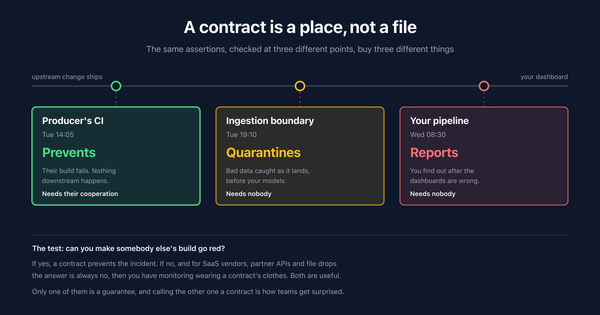
Soda's design premise is that a data quality check should be an explicit artifact. You write it, review it in a pull request, and it lives in Git next to the models it protects.
# SodaCL: every check is something a human wrote on purpose
checks for orders:
  - row_count > 0
  - missing_count(order_id) = 0
  - duplicate_count(order_id) = 0
  - freshness(created_at) < 24h
  - invalid_percent(status) < 1%:
      valid values: [pending, shipped, delivered]
That is a real position and I don't think it's wrong. If your team treats data contracts as reviewed artifacts, hand-authored YAML is the feature. You know exactly what fires and why, there is no model deciding what "normal" means, and a check that alerts is a check somebody chose.
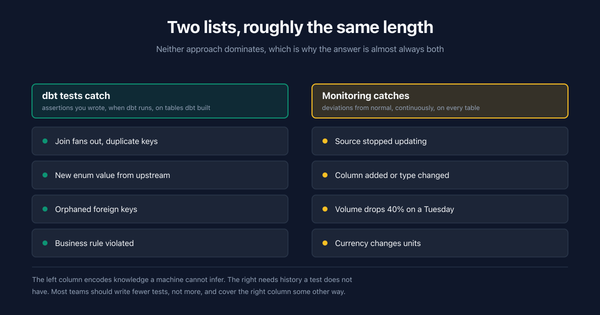
The cost is that somebody has to write all of them, and then keep writing them as tables get added. This is the same tension I wrote about in you don't need to write data tests: explicit checks are excellent for the rules you thought of and silent about everything else. A warehouse of 300 tables with hand-authored coverage usually means 40 tables are covered well and the rest are covered by hope.
The current CLI is Soda Core v4, which exposes soda contract verify, soda contract publish, soda cloud, and soda data-source. Through 2025 and 2026 Soda repositioned around AI, adding anomaly detection, collaborative data contracts, and automated remediation. Worth knowing if your impression of Soda is from 2023, when it was closer to a pure check runner.
What does Soda cost in 2026?
Soda publishes its pricing now, which is more than most of this category does, and they deserve credit for it.
| Tier | Price | What you get |
|---|---|---|
| Free | $0/month | Pipeline testing, metrics observability, alerting integrations, unlimited users, a bundled allocation of processing units |
| Team | $750/month | Everything above, plus collaborative data contracts, no-code authoring, AI quality features, RBAC, SSO, audit logs, private deployment, catalog integrations |
| Enterprise | Quoted | Book a call |
The number that matters is not on the page. Soda meters usage in Soda Processing Units, and beyond your bundled allocation SPUs are pay-as-you-go. The per-SPU rate is not published anywhere I could find, and annual billing carries volume discounts that are negotiated. So $750 is a floor, and your actual bill is $750 plus an amount that depends on how much data you process at a rate you have to ask for.
That is not a scandal. It is how most usage-based infrastructure is sold. It does mean that the honest way to evaluate Soda's cost is to run a real workload on the Free tier, watch your SPU consumption, and extrapolate, rather than to read the pricing page and multiply.
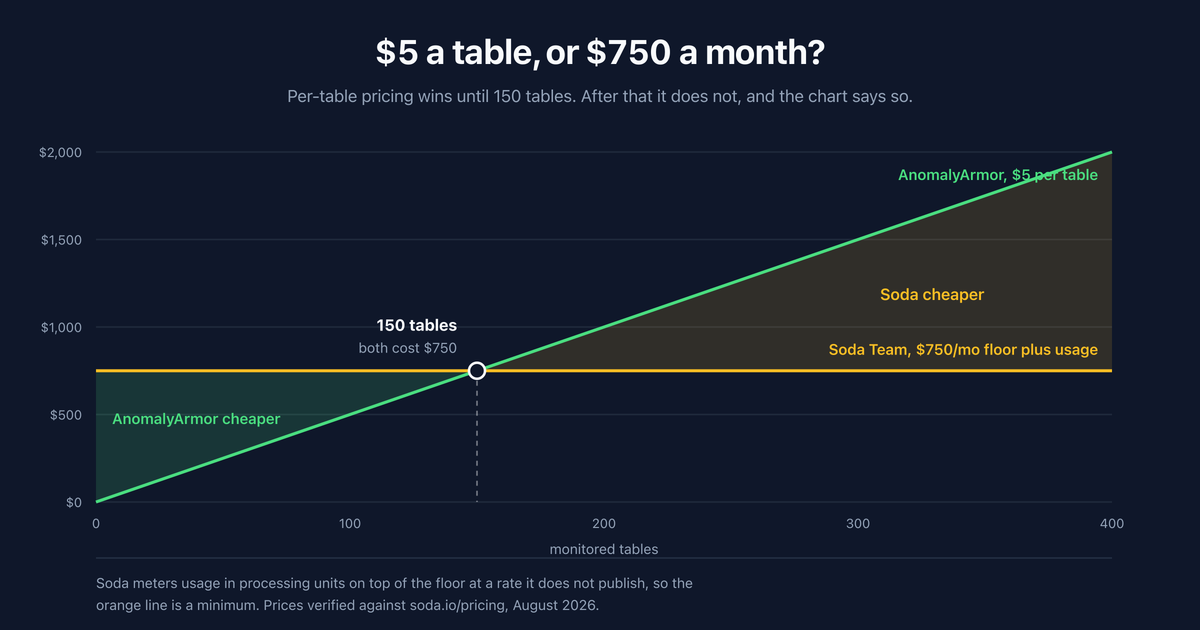
For comparison, AnomalyArmor is $5 per monitored table per month with no minimum and no usage component. I'd rather compete on a number you can compute in your head than on one you have to model. The general shape of what this category charges is in how much does data observability cost.
What changed with the Soda Core license?
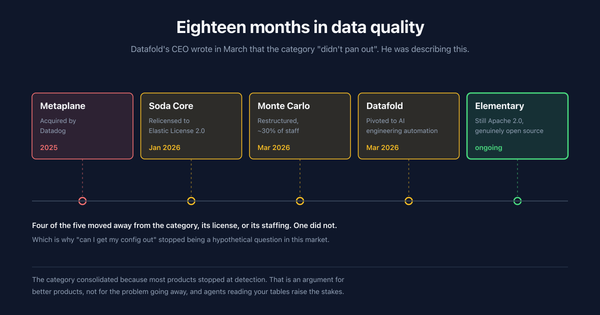
Soda Core moved from Apache 2.0 to the Elastic License 2.0, announced in January 2026. Soda Core is still free and you can still read, modify, and self-host the source. It is source-available rather than open source.
The restriction ELv2 adds is that you cannot provide the software to third parties as a hosted or managed service that exposes a substantial set of its functionality. If you run Soda Core internally, including in production, nothing about your situation changed.
Two reasons it belongs in a comparison anyway. First, plenty of teams pick tools partly on license, and "open source" is now the wrong word for Soda Core, including on pages that still say it. Second, this is the standard pattern where a company converts an open-source project into a funnel for a hosted product, and it usually predicts a widening gap between what the free thing does and what the paid thing does. That is worth pricing into a multi-year decision.
Soda is far from alone here. It is a normal 2026 move and I would expect more of them.
What did Soda's AI repositioning change?
Soda now describes itself as an AI-native data quality platform, with anomaly detection, collaborative data contracts, and automated remediation as the headline investments. The AI features sit on the Team tier.
Here is the thing about that: everybody did this. Monte Carlo, Anomalo, Metaplane before the acquisition, Soda, us. Walk the category's homepages in 2026 and you'll read four versions of the same paragraph. "AI-powered" has stopped carrying information, which is inconvenient for me too, because we genuinely are built around an agent and I have no way to say so that sounds different from everyone else saying it.
So the question worth asking is not whether a tool has AI. It's what the AI hands you when it's finished. An anomaly detector that says "row count is anomalous" is a threshold with better marketing. A useful one tells you what it expected, what range it considered normal, which method produced that range, and how much history it had to work with. That's the difference between a verdict you can calibrate and one you have to trust.
The same applies one level up, to whatever the tool says caused the problem. If the explanation is prose, you have no way to check it. If every claim in it points at a record you can open, you do. I wrote the long version of that argument in how do you know your data quality agent is right, and it's the only evaluation question in this category I'd call load-bearing right now.
None of that is a knock on Soda specifically. It's the question I'd put to any vendor in 2026, including whoever is reading this and evaluating us. Ask what the model was given, what it returned, and what you can click.
What are the real Soda alternatives?
Depends what you liked about Soda in the first place. Three different things send people looking.
| If you're leaving because | Look at | Why |
|---|---|---|
| You don't want to hand-author checks | AnomalyArmor, Anomalo | Both generate a baseline from the warehouse rather than from your YAML |
| You want checks in Git, but free | Great Expectations, dbt tests | Same explicit philosophy, no vendor. You supply the scheduler |
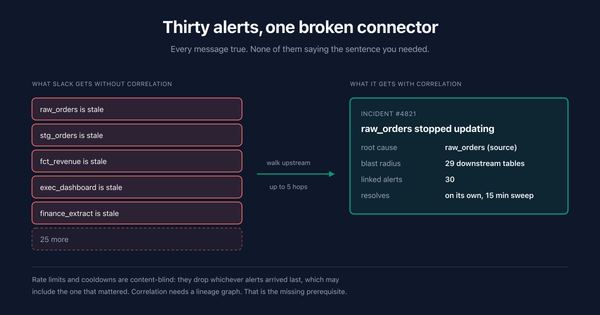
| You outgrew checks and want incidents | Monte Carlo, Bigeye | Lineage, incident management, and the price tag that comes with them |
| You already live in dbt | Elementary | Runs on top of dbt artifacts, minimal new surface |
The honest summary of each:
Great Expectations is the closest philosophical match: explicit expectations, Python-native, free. You still build the scheduler and the results store. I covered the trade in detail in the Great Expectations comparison.
dbt tests plus Elementary is the cheapest path if your transformations already live in dbt. Coverage stops where dbt stops, which means raw ingestion is invisible, and that is where most incidents start.
Monte Carlo and Bigeye are a different product category. If what you actually want is incident management across a large estate, they do that and Soda does not. Budget accordingly.
Anomalo is the closest to us on the auto-baseline axis and sells to a larger company than we do.
AnomalyArmor generates monitors from your schemas, prices at $5 per table, and hosts the runner. That's the pitch, and the rest of this post is the parts of it that don't flatter us.
The table-count crossover
Here is the arithmetic, because "cheaper" is meaningless without a table count.
Soda Team is $750/month regardless of size, plus SPUs. We're $5 per table per month with no floor. So we're cheaper below 150 tables and more expensive above it, and the crossover moves in Soda's favor as you grow.
| Monitored tables | AnomalyArmor | Soda Team (floor) | Cheaper |
|---|---|---|---|
| 25 | $125/mo | $750/mo | AnomalyArmor |
| 75 | $375/mo | $750/mo | AnomalyArmor |
| 150 | $750/mo | $750/mo | Even |
| 300 | $1,500/mo | $750/mo + SPUs | Soda |
| 1,000 | $5,000/mo | $750/mo + SPUs | Soda |
I could hide this table and most readers would never run the numbers. But a vendor who only publishes the comparison they win is telling you something about every other claim on the page, and you'd find out in month two anyway.
Two caveats that cut both ways. The SPU component means the Soda column is a floor, not a quote, so at 1,000 tables the real number could land anywhere above $750. And "monitored tables" is a choice: most warehouses have a few hundred tables and a few dozen that matter, so the row you should read is the one matching what you'd actually monitor, not what you own.
Below roughly 150 tables, talk to us. Above it, get a real quote from Soda with your SPU projection and compare against $5 per table honestly.
What does migrating off Soda actually cost?
This is the section I got wrong, so let me start there.
Until this week, our own website and docs told prospects to run soda export --odcs and paste the result into our migration tool. That command does not exist. Soda's CLI has no export command and no ODCS flag, and ODCS is not mentioned in Soda's documentation at all. We inherited the assumption from a planning document, built a landing page on it, and nobody checked. It is fixed now.
I'm telling you because the lesson generalizes past my embarrassment: every vendor's migration page is the least-verified page on their site. It's written by marketing, it's rarely tested, and the cost of being wrong lands on you during a migration you already committed to. Before you believe any "one-command import" claim, run the command.
So the real answer for Soda: there is no automated path today, from us or anyone. SodaCL is not ODCS, and in the datacontract-cli ecosystem SodaCL is an export-only target, so you can turn ODCS into SodaCL but not the reverse.
What that means in practice:
# What actually works, once you have an ODCS contract
armor contract apply --asset <uuid> -f contracts/orders.yaml

# What works automatically today, for other tools
armor migrate-from dbt ./my-dbt-project/ > contracts/
armor migrate-from great-expectations ./great_expectations/ > contracts/
Translating SodaCL by hand is mechanical rather than hard. Most check types have direct equivalents: row_count, missing_count, duplicate_count, freshness, and invalid_percent with a valid-values list all map onto standard contract primitives. Custom SQL checks port as custom SQL checks. Budget an afternoon for a few dozen checks, and rather less if you let an LLM do the first pass and review the diff.
The thing that makes this less painful than it sounds is that under an auto-baseline tool you don't port everything. You port the checks that encode business knowledge a machine can't infer, which is usually a minority of them, and you let the baseline regenerate the row-count and null-rate monitors you'd otherwise be transcribing.
When Soda is the right call
Four situations where I'd tell you to stay.
You have more than a few hundred monitored tables. The crossover table above is the whole argument. Per-table pricing stops being charming at scale.
Your team wants every check to be explicit. Some organizations need to point at the exact YAML that produced an alert, for audit reasons or cultural ones. An inferred baseline is a worse fit no matter how good the inference is.
You're already deep in SodaCL. A large, well-maintained check library is a real asset, and the migration cost is real, and "the other tool is a bit cheaper" does not clear that bar.
You need SSO, RBAC, and private deployment today. Those are on Soda's Team tier now. Check what your candidate actually ships rather than what its roadmap says.
What should you test during an evaluation?
Four tests, none of which take longer than an afternoon, all of which are more predictive than a feature grid.
- Run the migration command. Whatever the vendor's migration page says, run it before you believe it. This is the cheapest lie to catch and the most expensive one to discover late.
- Point it at your ugliest table. Not the clean fact table. The one with the inconsistent nulls, the seasonal volume, and the column somebody renamed. Every tool looks good on
dim_date. - Break something on purpose and time it. Drop a column in a staging copy. Measure detection time and how much of the answer arrives with the alert versus how much you have to go find. The methods behind that detection matter, and the anomaly detection guide covers what to ask about.
- Export your config and read it. If you can't get your monitoring definitions out in a format another tool reads, you've bought a subscription and a hostage. Ask for the export on day one, not the day you leave.
That last one is the reason our config is ODCS YAML, and I'll note the asymmetry plainly: exporting from us is a documented command, while exporting from Soda into anything is currently not. That is a real advantage for us and a real gap for them, and it's also the kind of thing that changes when a vendor decides to ship an exporter, so check it yourself when you read this rather than taking my word for the state of it.
Frequently asked questions
What is the best Soda alternative in 2026?
It depends on why you're leaving. For teams tired of hand-authoring checks, AnomalyArmor and Anomalo generate a baseline instead. For teams that want the explicit-check philosophy without a vendor, Great Expectations. For teams that need incident management across a large estate, Monte Carlo or Bigeye.
How much does Soda cost?
Soda publishes a $0 Free tier and a Team tier at $750 per month, with Enterprise quoted. Both paid tiers meter usage in Soda Processing Units beyond a bundled allocation, and the per-SPU rate is not published, so treat $750 as a floor rather than a quote.
Is Soda Core still open source?
No. Soda Core relicensed to the Elastic License 2.0, announced January 2026. It remains free and source-available, and internal production use is unaffected. You cannot offer it to third parties as a hosted or managed service.
Can I import my Soda checks automatically?
Not into any tool I know of, including ours. Soda has no ODCS export, and SodaCL is an export-only format in the datacontract-cli ecosystem, so there is no automated SodaCL-to-anything path. The translation is manual.
How long does migrating off Soda take?
An afternoon for a few dozen checks, mostly mechanical. The step people underestimate is deciding which checks to port at all, since under an auto-baseline tool the row-count and null-rate checks regenerate themselves and only the business-logic ones need to move.
Does Soda support ODCS?
Not as of this writing. Soda's CLI reference documents no export command and no ODCS flag, and ODCS does not appear in their documentation index. Several comparison pages on the internet claim otherwise, including one of ours until recently.
When is Soda cheaper than AnomalyArmor?
Above roughly 150 monitored tables, where our $5 per table passes their $750 monthly floor. Below that we're cheaper, and the gap widens as the table count drops.
What is a Soda Processing Unit?
Soda's usage metering unit. Each plan bundles an allocation and additional units are billed pay-as-you-go. Because the rate is not public, the practical way to estimate your bill is to run a representative workload on the Free tier and watch consumption.
Is SodaCL hard to learn?
No, and that is not the objection. It is a readable YAML DSL that most data engineers pick up in an hour. The cost is the ongoing authoring discipline across a growing warehouse, not the initial learning curve.
Does AnomalyArmor replace dbt tests?
It covers different ground. dbt tests validate transformation logic you wrote; monitoring watches for things nobody wrote a rule about, including in raw tables upstream of dbt. Most teams keep both and stop expanding the test suite.
What happens to my custom SQL checks?
They port as custom SQL checks. Any tool worth evaluating supports arbitrary SQL, so a custom check is the piece most likely to survive a migration unchanged.
Should I run both tools in parallel during a switch?
Yes, for a week or two. Keep the old alerts firing while the new tool runs silently, compare what each catches, and only then cut over. Anything that fires in one and not the other is either a coverage gap or a false positive, and both are worth knowing before you're relying on it.
How do I evaluate a data quality vendor's claims?
Run the commands on their migration page, point the tool at your worst table rather than a clean one, break something deliberately and time the detection, and confirm you can export your config before you depend on the product.