What Is a Data Quality Agent?
A data quality agent is software that watches your warehouse, investigates problems, and explains them on its own, instead of making you check a dashboard. Here's what that means, how it differs from rule-based monitoring, and why the category showed up in 2026.
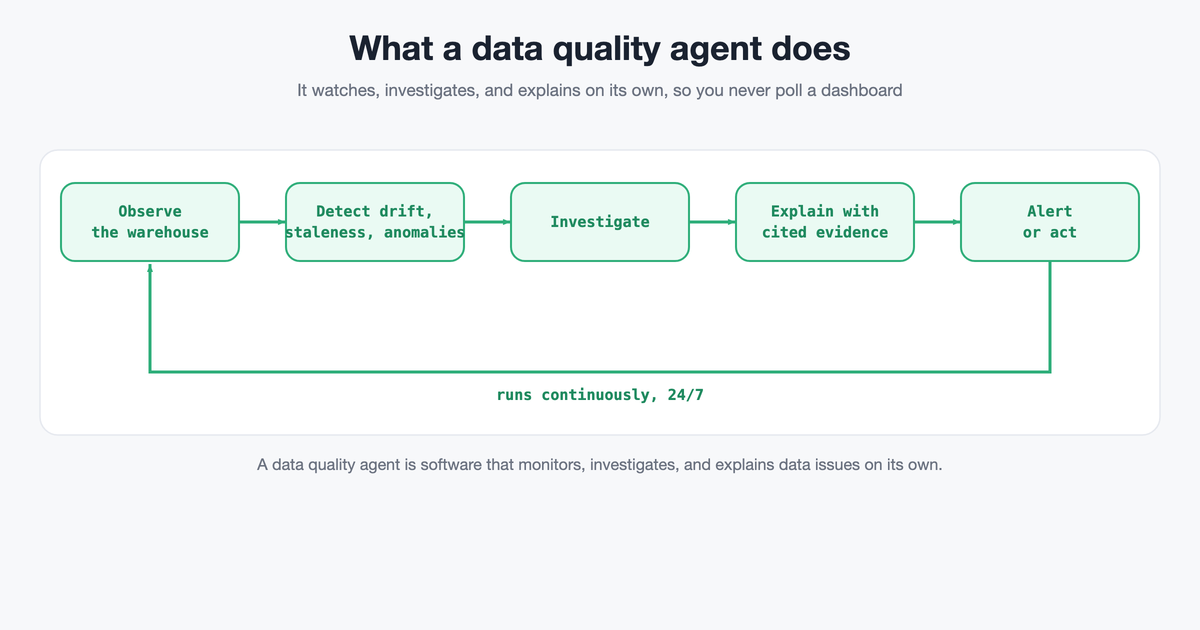
A data quality agent is software that continuously monitors your data, detects problems, investigates the likely cause, and explains what happened in plain language, without a human writing rules or watching a dashboard. It's the agentic version of data quality monitoring. Instead of maintaining a static set of tests and staring at charts, you let an agent watch the warehouse, decide what's worth flagging, and do the first pass of the investigation for you.
That's the short definition. The longer answer matters, because "agent" is getting stapled onto every data tool this year, and most of what's branded that way is a chatbot bolted to an old dashboard.
What a data quality agent actually does
Strip away the marketing and an agent runs a loop. It observes the warehouse, detects something off, investigates it, explains the finding with evidence, and then alerts or acts. Then it does it again, continuously, without being asked.
- Observe. It watches schema, freshness, row counts, distributions, lineage, and job history across your tables. Not a table you pointed it at once. All of them, on an ongoing basis.
- Detect. It learns what normal looks like for each table and flags deviations: a column that changed type, a load that's twelve hours late, a null rate that tripled overnight.
- Investigate. This is the part that separates an agent from an alert. When something breaks, it correlates across sources to find the likely cause: the upstream schema change, the failed sync, the lineage path to the affected dashboard.
- Explain. It writes up what it found in language a human can read, ideally with links back to the exact records so you can check its work.
- Alert or act. It tells the right person, or, in narrow cases you've approved, takes an action.
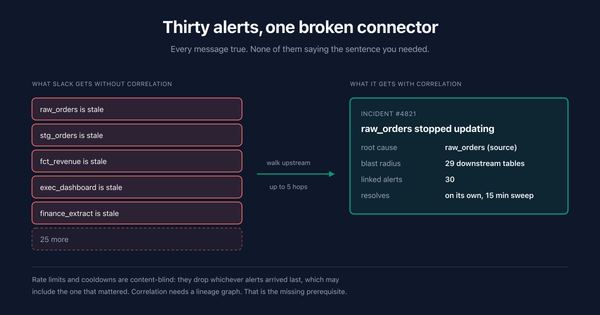
The rule-based tools most teams run today stop at step two. They detect and they alert. Steps three and four, the investigation and the explanation, land on a data engineer at 7am. The agent's whole point is to do that pre-work before you wake up.
Data quality agent vs traditional data quality monitoring
The difference isn't cosmetic. It changes who does the work.
| Rule-based monitoring | Data quality agent | |
|---|---|---|
| Setup | You write and maintain tests per table | It learns each table's normal behavior |
| Coverage | Only what you remembered to write a rule for | The whole warehouse, including tables you forgot |
| When something breaks | You get an alert | You get an alert, a likely cause, and the evidence |
| Investigation | Human, manual, from scratch each time | Done by the agent as a first pass |
| Output | A red check and a threshold | A plain-language explanation you can verify |
| Failure mode | Silent gaps where no rule exists | Over-flagging if the agent isn't tuned |
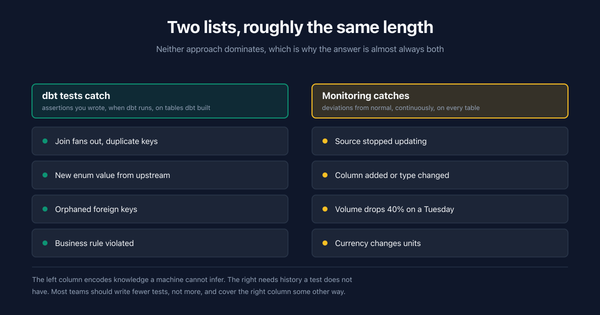
Rule-based testing isn't wrong. dbt tests and Great Expectations catch real problems, and they're precise about the things you thought to encode. The trouble is everything you didn't think to encode. Nobody writes a test for the column that doesn't exist yet, or the freshness SLA on the table a teammate added last quarter. Coverage tracks your memory, and your memory has holes. An agent's pitch is that it covers the holes.
Why the category showed up in 2026
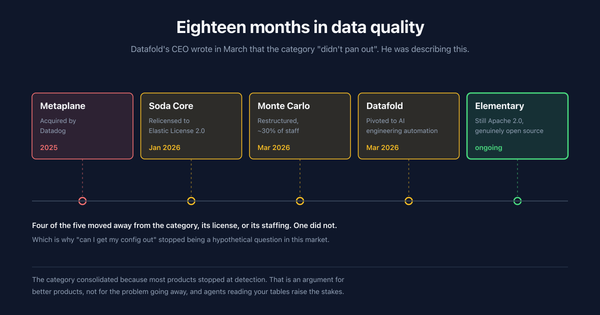
Two years ago "data quality agent" wasn't a phrase anyone used. Now the whole market is shipping one. Monte Carlo launched its first Observability Agents in April, split into a monitoring agent and a troubleshooting agent that does root-cause analysis. Acceldata sells a Data Quality Agent that promises to find, fix, and prevent issues. Actian shipped a suite of observability agents for detection, diagnosis, and routing. When the incumbents all move at once, the category is real.
The reason is that the underlying models finally got good enough to do the investigation step. Correlating a freshness failure with an upstream schema change and a broken lineage edge used to require a human who knew the warehouse. A model with the right context can now do the obvious 80% of that reasoning, which is exactly the part that eats a data engineer's morning. The bottleneck was never detection. It was the tedious middle work between an alert firing and a human understanding it.
What separates a real agent from a wrapper
Here's the position: most "agents" being sold are a language model draped over a product that already existed, and you can tell the difference by asking three questions.
Can it show its evidence? An agent that hands you a confident paragraph with no links is worse than a dumb alert, because now you have to trust prose you can't check. A real agent cites the row. When it says "the upstream sync failed at 19:04," you should be able to click through to that exact record. We built our investigation output, EvidenceCapsule, specifically so every claim points back to a verifiable record, because an investigation you can't audit isn't worth much.
Does it maintain memory, or re-derive everything each time? A good agent builds a persistent, structured picture of your warehouse and keeps it current, so it isn't relearning your schema on every question. We treat that knowledge base as a living document the agent maintains rather than a pile of chunks it re-embeds each time.
Does it live where you work, or in one more tab? The agents bolted onto legacy platforms still make you go to their dashboard. The more useful shape is one that answers from inside the AI assistant you already use, so the investigation happens where you're already working.
If a tool fails those three, it's a wrapper. It'll demo well and frustrate you by week two.
Data quality agent FAQ
Is a data quality agent the same as data observability?
Not quite. Data observability is the broader practice of knowing the state of your data across freshness, schema, volume, quality, and lineage. A data quality agent is a way of delivering that: an autonomous system that does the watching and the first-pass investigation instead of a dashboard you monitor. The agent is the how, observability is the what.
Does it replace dbt tests?
No, and be suspicious of anyone who says it does. Explicit tests are great for the specific invariants you know matter, like a primary key that must be unique. An agent covers the long tail you never wrote tests for and does the investigation when something fails. Run both. They solve different halves of the problem.
Will it flood me with false positives?
That's the real risk, and it's the honest downside of the category. An agent that flags everything is as useless as no monitoring. The thing to evaluate is whether it learns each table's baseline and whether you can tune its sensitivity, not whether the demo looked slick.
Do I need to write rules to start?
With a well-built agent, no. It should profile your tables, learn their normal behavior, and start watching without you authoring a test suite first. Writing rules is optional refinement, not a prerequisite.
What data does it need?
Metadata, mostly: schema, load times, row counts, distributions, and lineage. A good agent works off the information your warehouse already exposes, so it doesn't need to copy your actual rows to do its job.
AnomalyArmor is a data quality agent for Snowflake and Databricks teams, currently in private beta. If you want it watching your warehouse instead of another dashboard you have to remember to check, reach out and we'll get you access.