What Is the Best Datafold Alternative in 2026?
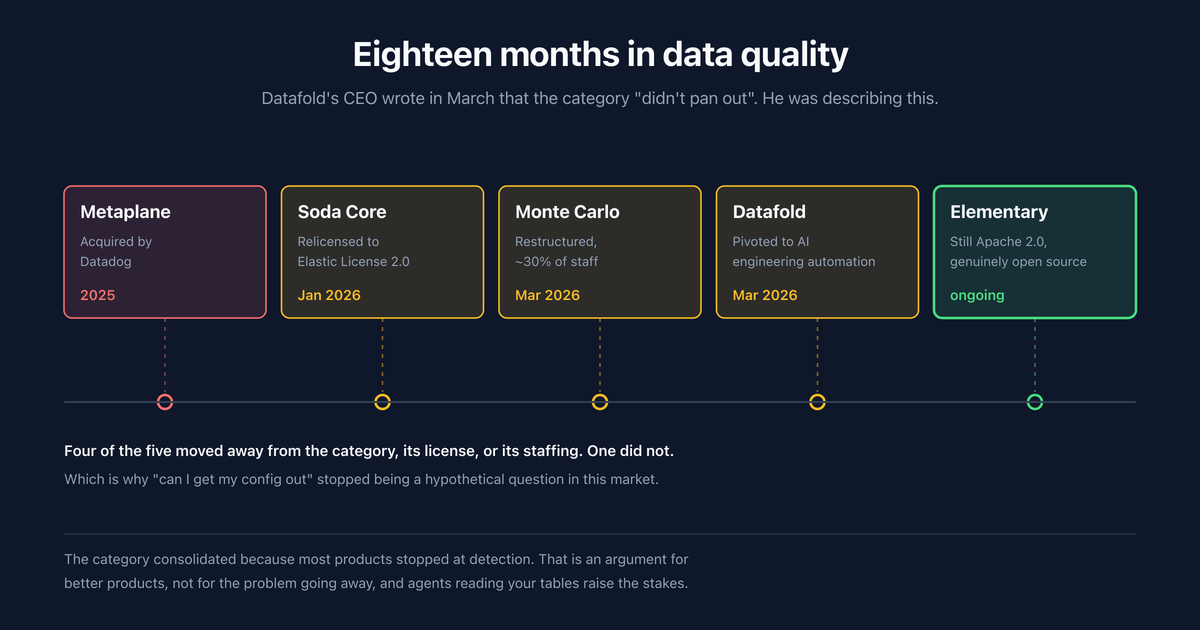
Datafold's CEO wrote in March that data quality "didn't pan out" as a category, and pivoted. If you bought it for data quality, that is your answer.
Datafold is a data diffing tool that compares two versions of a table, or the same table across two databases, and reports value-level differences. It was built for the moment before you merge a dbt change, to answer "what will this actually do to the numbers." At that job it is excellent and mostly unmatched.
It is also, as of 2026, no longer primarily a data quality company. Their CEO said so in public, which is unusual and worth taking seriously.
What did Datafold's CEO actually say?
On March 5, 2026, Gleb Mezhanskiy published a predictions piece that included a candid assessment of the category his own company helped define.
His argument, in short: data quality was a major topic five years ago, numerous startups took significant VC funding to solve it, and after years of R&D "data teams are still largely in the same spot with data quality." He notes those startups "haven't achieved nearly the same outcomes as the software darlings like Datadog."
Then the part about his own company: "At Datafold, we spent several years focused almost exclusively on automating data quality as part of our broader mission to automate data engineering." The company has since reoriented toward context layers and knowledge graphs for AI agents. Datafold's homepage now leads with AI-powered migrations, code optimization, and development rather than data quality.
The sharpest line is a prediction: data teams will stop chasing data quality because AI doesn't care about data quality, and context and metadata will matter more than quality assertions.
I sell a data quality product. You would expect me to argue with this. I only half do, and the half I agree with is the more important half.
Is he right?
Partly, and the part he's right about is damning.
The category did underdeliver commercially. Monte Carlo, Bigeye, Metaplane, Soda, Anomalo, Acceldata all raised large rounds on a story about becoming the Datadog of data. None became it. Metaplane was acquired by Datadog rather than becoming it, which is a fairly literal outcome. Monte Carlo restructured. The category consolidated instead of compounding.
The tools did underdeliver technically. Most of them shipped a dashboard of anomalies and left the hard part, working out which anomaly matters and why, to a human at 07:00. I've written about that gap in what separates a real agent from a wrapper and I think it explains most of the disappointment. If the product's output is "row count looks unusual," the customer's problem is untouched.
Where I disagree is the AI part. The claim that AI doesn't care about data quality is exactly backwards in the way that matters. A human reading a wrong number often notices it's wrong, because they know last month's number. An agent reading a wrong number acts on it, then writes it somewhere, then another agent reads that. Bad data used to produce a bad slide. It now produces a chain of confident actions nobody reviewed.
What I think he's right about underneath the disagreement: context and quality are the same problem, and the tools that sold quality assertions without context were selling half a product. That is also why we built a knowledge base layer rather than a metrics dashboard, which I wrote up in OKF vs RAG. Datafold and I appear to have reached similar conclusions and gone different directions with them.
What happened to open source data-diff?
Sunset on May 17, 2024. Datafold announced they would "no longer actively support or develop open source data-diff," redirecting effort to Datafold Cloud, with the CEO citing the cost of maintaining two products with overlapping functionality.
This matters if your Datafold usage is actually the OSS tool in a CI job. That code still runs; unmaintained is not the same as deleted. But it does not get new database adapters, it does not get fixes, and every month it drifts further from the warehouse versions it was written against.
It also fits a pattern worth naming. Datafold sunset its OSS project in 2024, Soda Core relicensed to Elastic License 2.0 in January 2026, and Metaplane was absorbed into Datadog. The free and open tier of this category has been shrinking for two years, and Elementary is now conspicuous for still being Apache 2.0.
What does diffing look like without Datafold?
If you decide to replace the diff half, it helps to see what you're actually replacing, because "just write EXCEPT queries" hides a lot.
The naive version, which is what most teams reach for first:
-- What is in dev that is not in prod, and vice versa
SELECT 'only_in_dev' AS side, * FROM dev.fct_revenue
EXCEPT
SELECT 'only_in_dev' AS side, * FROM prod.fct_revenue

UNION ALL

SELECT 'only_in_prod' AS side, * FROM prod.fct_revenue
EXCEPT
SELECT 'only_in_prod' AS side, * FROM dev.fct_revenue;
This works and it is genuinely useful once. Its problems show up the second time. It scans both tables in full, so on anything large you are paying real warehouse money per comparison. It tells you rows differ without telling you which column moved. Nulls do not behave the way you expect. And it cannot compare across two different databases at all, which is the case that matters most during a migration.
The dbt package version is better and still in-warehouse:
-- macros or an analysis file, using dbt-audit-helper
{{ audit_helper.compare_relations(
    a_relation=ref('fct_revenue'),
    b_relation=api.Relation.create(
        database='prod', schema='analytics', identifier='fct_revenue'
    ),
    primary_key='order_id'
) }}
compare_relations gives you row counts by match status, and compare_column_values narrows it to which column diverged. Free, runs where your data is, and requires you to know the primary key.
What you give up relative to a product built for this: sampling strategies that avoid full scans, cross-database comparison, a diff UI your reviewers will actually read, and CI integration that comments on the pull request. Those are the things worth $30,000 a year to a team doing a warehouse migration, and worth nothing to a team that diffs twice a year.
My rule of thumb: if you are mid-migration, the commercial diff tool pays for itself in a quarter. If you are steady-state, the dbt package is enough and the money belongs somewhere else.
What does Datafold cost?
Not published, which by itself tells you the motion.
Third-party marketplace data suggests teams with 5 to 15 data sources and under 10TB commonly land in a $30,000 to $75,000 annual range, with 20+ sources reaching $100,000 or more, and multi-year commitments cutting 15 to 25%. Treat those as reported estimates rather than a price sheet, because there isn't one.
For comparison across the category:
| Tool | Pricing | Published? |
|---|---|---|
| Datafold | ~$30k to $100k+/year (reported) | No, quoted |
| Monte Carlo | Enterprise, quoted | No |
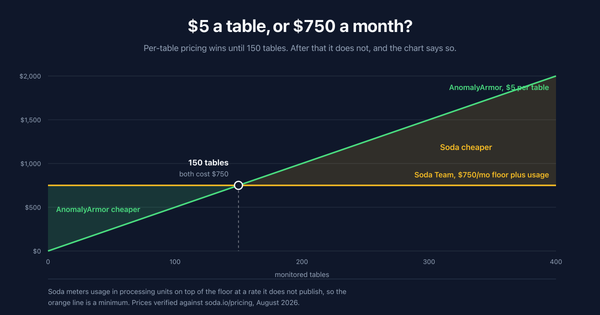
| Soda | $0 Free, $750/mo Team plus usage | Yes |
| Elementary Cloud | Seats plus tables, quoted | No |
| AnomalyArmor | $5/table/month | Yes |
The pattern is that the tools solving the biggest problems charge the most and tell you the least, which is normal enterprise software and not a scandal. It is worth knowing before you book the call.
Why did the category consolidate?
Worth understanding, because it predicts which vendors survive the next two years and you are about to sign a contract with one of them.
Four things happened at once.
The wedge was too narrow to become a platform. Datadog works because once you have agents on every host, you can sell logs, then APM, then security, then everything. Data quality tools connect to a warehouse and watch tables. There is no equivalent second act, so revenue per customer plateaus and the growth story with it.
The buyer was underfunded. Observability sells to platform engineering teams with real budget authority. Data quality sells to data teams, who in most organizations are a cost center defending headcount. The same product sold to a different buyer is a different business.
The output was not actionable. This is the one I keep returning to. A tool that says "row count on orders is 3 standard deviations below normal at 04:00" has moved work, not removed it. Somebody still has to decide whether that matters, find the cause, and tell the people downstream. Selling a subscription for the first 10% of a job is a hard renewal conversation in year two.
Warehouses ate the easy parts. Snowflake and Databricks shipped their own monitoring, and free-tier features have a way of capping what an adjacent vendor can charge for the same thing.
| Vendor | What happened | When |
|---|---|---|
| Metaplane | Acquired by Datadog | 2025 |
| Monte Carlo | Restructured, roughly 30% of staff | March 2026 |
| Datafold | Pivoted to AI engineering automation | March 2026 |
| Soda | Soda Core relicensed to ELv2 | January 2026 |
| Elementary | Still Apache 2.0, cloud tier growing | Ongoing |
That table is why I take Mezhanskiy's essay seriously rather than treating it as a competitor talking his book. He is describing a real pattern and he included his own company in it, which most people would not.
Where I land differently is on the conclusion. The category disappointed because the products stopped at detection. That is an argument for better products, not for the problem being unimportant, and the arrival of agents that read your tables and act without a human in the loop makes it more urgent rather than less.
What are the alternatives, and to which half?
This is the part most "alternative" posts get wrong, because Datafold does two separable jobs and they have completely different replacements.
If you use Datafold for data diffing (pre-merge impact, migration validation, comparing across databases), your alternatives are narrow. Nobody in the observability category does value-level diffing well, us included. Options:
dbt-audit-helper, a dbt package withcompare_relationsmacros. Free, in-warehouse, and considerably more manual.- Warehouse-native comparison, meaning writing the EXCEPT queries yourself. Works, does not scale past a handful of tables.
- Recall that Datafold Cloud still does this and still does it well. Their pivot is about positioning, not about deleting the diff engine.
Honestly, if diffing is your use case, the answer is often to keep Datafold. It's the best tool for that job and the pivot doesn't change it.
One more distinction inside the diffing half. Datafold's diff engine is used two ways, and only one of them is hard to replace. Ad-hoc diffing, where somebody compares two tables during an investigation, is well served by the dbt package. Automated diffing in CI, where every pull request gets a comment showing what the change does to the numbers, is the version that changes team behaviour, and it is the version nothing free replicates. If your pull requests carry diff comments today, removing that is a process change rather than a tooling swap, and people will notice.
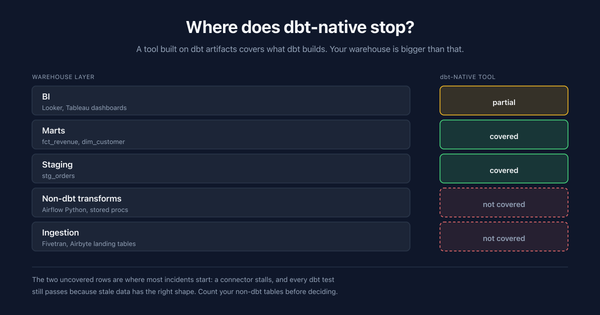
If you use Datafold for data quality monitoring, the field is wide: Monte Carlo and Bigeye at the enterprise end, Soda and Great Expectations for explicit checks, Elementary if you're all dbt, and us at $5 per table with auto-generated baselines. I compared several in what tools should I use for data observability.
The question to answer first is which half you're actually paying for. A surprising number of teams bought the platform for diffing and quietly stopped using the monitoring, or the reverse.
Does a vendor pivot mean you should leave?
Not automatically, and the reflex to panic is worth resisting.
A pivot means the roadmap moves. It does not mean the product stops working, and it does not mean support disappears. Datafold Cloud has customers, revenue, and a diff engine that is still the best of its kind.
What it does mean, concretely:
- New investment goes elsewhere. The features you want in the deprioritized half arrive slowly or not at all.
- The next contract is a different conversation. You are renewing a product whose vendor has publicly said your use case is not the mission.
- The exit gets more expensive over time. Config that lives only in a vendor's UI is harder to move each year it accumulates.
The reasonable response is not a migration, it's a check: can you get your config out? That's the question I would ask of any vendor in a consolidating category, and it's why our config exports as ODCS YAML with a documented command. Not because it's clever, but because "can I leave" is now a live question in this category rather than a hypothetical one.
What should you do about it?
Four steps, none of which is "switch."
- Work out which half you use. Open your Datafold account and look at what runs. Diffs in CI, or monitors on tables? The answer decides everything downstream.
- If it's diffing, stay and stop worrying. You're using the part that still is the product. Revisit at renewal.
- If it's monitoring, price the alternatives now rather than at renewal. You have time, which is the best possible position to negotiate or migrate from.
- Export your config regardless. Whatever you decide, having your definitions outside the vendor is worth an afternoon. This applies to us too.
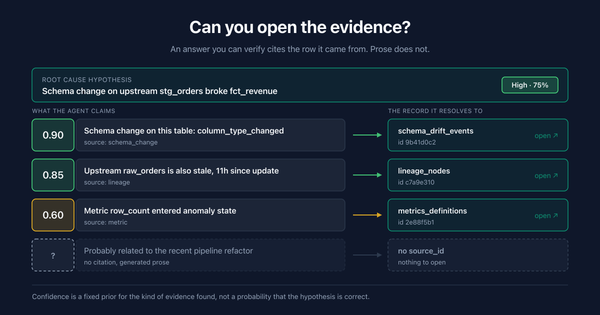
The larger point I'd take from Mezhanskiy's essay is not that data quality is dead. It's that a category which mostly shipped dashboards deserved the disappointment it got, and the tools worth paying for now are the ones that do something with a finding instead of displaying it. He concluded that means context for agents. I concluded it means an agent that investigates and cites its evidence. Those are closer than they look.
Frequently asked questions
What is the best Datafold alternative in 2026?
Depends which half you use. For data diffing, the honest answer is usually Datafold itself, with dbt-audit-helper as the free fallback. For data quality monitoring, Monte Carlo, Bigeye, Soda, Elementary, or AnomalyArmor depending on your budget and stack.
Did Datafold stop doing data quality?
It deprioritized it. In March 2026 their CEO wrote that the category "didn't pan out" and described Datafold's reorientation toward context layers and knowledge graphs for AI agents. The product still exists; the mission moved.
Is open source data-diff still maintained?
No. Datafold announced on May 17, 2024 that it would no longer actively support or develop it, in order to focus on Datafold Cloud. The existing code still runs but receives no new adapters or fixes.
How much does Datafold cost?
It is not published. Third-party marketplace data reports roughly $30,000 to $75,000 a year for 5 to 15 sources under 10TB, and $100,000+ for larger deployments. Treat those as estimates and get a quote.
What is data diffing and do I need it?
Comparing two versions of a table value by value to see exactly what a change did to the data. It is most valuable before merging a transformation change and during a warehouse migration. It answers a different question from monitoring, which watches production over time.
Can data quality monitoring replace data diffing?
No. Monitoring tells you production drifted from its own history. Diffing tells you what a proposed change would do before you ship it. Teams doing serious migration work usually need both.
Is the data quality category actually dying?
The commercial category consolidated: Metaplane went to Datadog, Monte Carlo restructured, Datafold pivoted, Soda relicensed. The problem did not go away, and if anything agents reading your tables make it more consequential. What died is the belief that a dashboard of anomalies is a product.
Does AI reduce the need for data quality?
I'd argue the opposite. A human reading a wrong number often catches it because they remember last month's. An agent acts on it, writes the result somewhere, and another agent reads that. The blast radius of bad data goes up when the consumers are automated.
Is Datafold worth it during a warehouse migration?
Usually yes, and this is the strongest case for the product. Cross-database value-level comparison at scale is exactly what a migration needs and exactly what the free alternatives cannot do. A migration is also finite, so a one-year contract against a defined project is an easier decision than an open-ended monitoring subscription.
Can I diff tables across two different databases without Datafold?
Not easily. In-warehouse approaches like EXCEPT and dbt-audit-helper need both relations queryable from one engine. Cross-database comparison means extracting both sides somewhere neutral, which is the problem the commercial tools were built to solve.
What is dbt-audit-helper?
A dbt package with macros like compare_relations for comparing two relations inside your warehouse. It is the free, more manual alternative to a diffing product, and it works well enough for occasional comparisons.
Why did so many data quality vendors consolidate?
Four reasons together: the wedge was too narrow to grow into a platform, the buyer had less budget authority than the observability buyer, the output stopped at detection rather than resolution, and the warehouses shipped competing features for free. None of those mean the underlying problem went away.
Should I worry when a vendor pivots?
Enough to check whether you can export your configuration, not enough to start an unplanned migration. A pivot moves the roadmap, not the running product. Use the time to price alternatives before renewal rather than during it.
Why do so many data quality tools hide their pricing?
Because they sell to enterprises through a sales motion, where pricing is a negotiation. It is normal, and it does mean evaluation costs you a call. Published pricing exists in the category, it just clusters at the lower end.
What should I ask a vendor in a consolidating category?
Ask how to export your configuration and then actually run the command. Ask what happened to their open source project. Ask what the roadmap looks like for the half of the product you use, rather than the half they are excited about.