What Is the Best Bigeye Alternative in 2026?
Bigeye is an enterprise data observability platform priced for enterprise procurement. An honest comparison with AnomalyArmor: what Bigeye does well, where its pricing and sales model is a mismatch for mid-market teams, and when each tool is the right call.
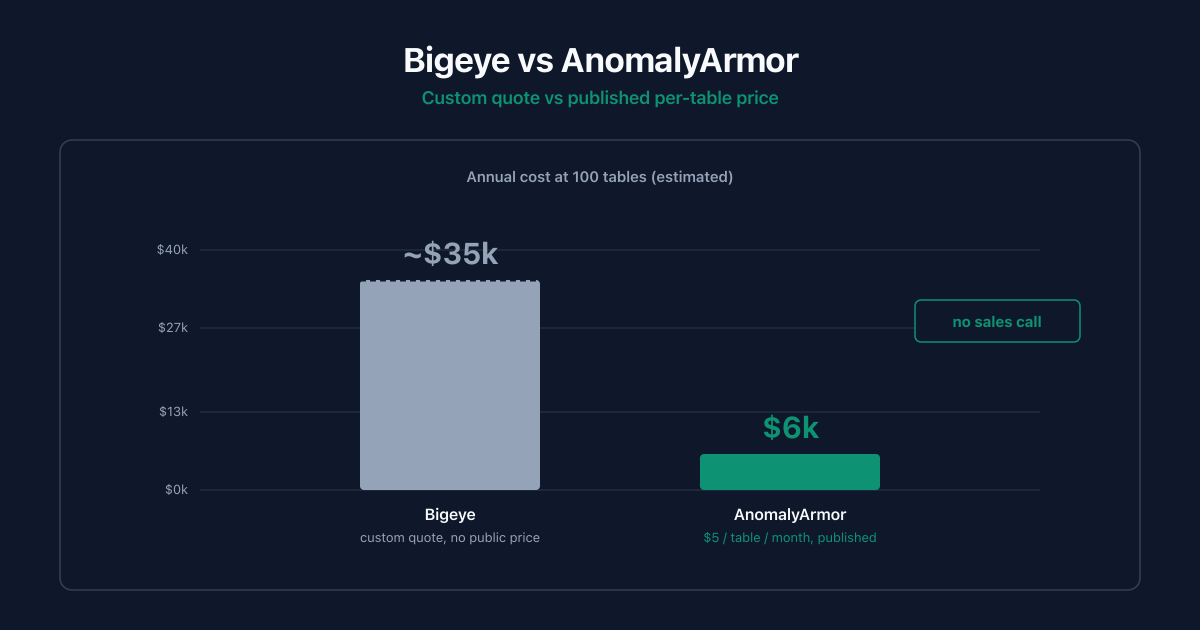
A Bigeye alternative is a data observability tool that delivers schema, freshness, volume, and distribution monitoring without Bigeye's enterprise contract structure, which is custom-quoted, typically lands in the five-figure annual range, and requires a sales cycle before you see a price. The most common reason teams search for one in 2026 is the same reason that drives buyers off Monte Carlo: the gap between what mid-market warehouses actually need and what enterprise observability vendors charge to provide it.
I built AnomalyArmor, so this is a biased source. Verify the numbers against Bigeye's own site and your own quote, and decide for yourself. What follows is the comparison I would want as a buyer: where Bigeye is genuinely strong, where its sales motion is a poor fit for non-enterprise teams, and where a transparent standalone tool is a more sensible default.
Why are data teams looking for a Bigeye alternative now?
Three reasons, all structural.
First, pricing is opaque. Bigeye does not publish list pricing. Buyers learn the number through a sales conversation that includes scoping, source counts, and table volume. For an enterprise procurement team that is routine. For a mid-sized data team trying to evaluate three tools in a week, it is a friction tax that competing vendors with published per-table pricing do not impose.
Second, the sales motion assumes enterprise. Bigeye's product is built for, and sold to, organizations with a data platform team, an internal champion, and a procurement process that absorbs months of evaluation. That is a real and defensible market. It is also not where most data teams live.
Third, the data observability category has consolidated. Metaplane was acquired by Datadog in April 2025. Monte Carlo cut roughly 30% of staff in March 2026. Buyers are reasonably weighing vendor independence and pricing transparency as first-class criteria now, not afterthoughts.
| Trigger | Detail | Buyer concern |
|---|---|---|
| Opaque pricing | No public price; sales-led quoting | Hard to evaluate or budget without a sales cycle |
| Enterprise sales motion | Built around large accounts with internal champions | Mismatch with mid-market team size and procurement |
| Category consolidation | Datadog acquired Metaplane; Monte Carlo restructured | Independence and pricing stability matter more than they used to |
How much does Bigeye cost compared to AnomalyArmor?
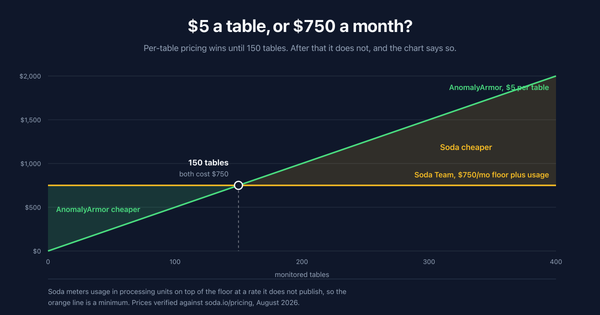
Bigeye does not publish pricing. Third-party marketplace data and public references put enterprise deployments in the same five-figure range as other enterprise observability tools, typically scaling with table count, source count, and monitor depth. AnomalyArmor is a published $5 per table per month.
| Scenario | Bigeye (custom quote) | AnomalyArmor ($5/table/mo) |
|---|---|---|
| 50 tables | Custom (typically five figures) | $3,000/yr |
| 100 tables | Custom (higher) | $6,000/yr |
| 250 tables | Custom (enterprise quote) | $15,000/yr |
| 500 tables | Custom (enterprise quote) | $30,000/yr |
The unknown number is itself the relevant data point. A tool that requires a sales cycle to learn the price is structurally a slower decision than a tool that publishes one. That is fine if your buying motion is enterprise. It is friction if your buying motion is "evaluate three tools, pick one, deploy this quarter."
What does Bigeye do well?
A fair comparison says what the competitor is good at, plainly.
- Autometrics and SLA-driven monitoring. Bigeye built its reputation on automatic metric coverage and SLA workflows that map cleanly to enterprise reliability practices. If your data team operates with formal SLAs and runbooks, that workflow shape is well-supported.
- Enterprise integrations and security. SSO, RBAC, deployment options, and the procurement and compliance apparatus large enterprises require are all there.
- Origins in real production data work. Bigeye's founding team came out of Uber's data quality group, and that pedigree shows in the depth of the platform's metric coverage and incident workflow.
- Track record at scale. Bigeye has been deployed in large, complex warehouses with hundreds to thousands of tables and the platform handles that footprint.
If you are an enterprise with an SLA culture and a procurement team, Bigeye is a defensible default and you should evaluate it seriously on its merits.
What does AnomalyArmor do that Bigeye does not?
AnomalyArmor covers the same monitoring core (schema drift, freshness, volume, distribution, custom SQL, alerting, dbt, lineage) and adds:
- Published, transparent pricing. $5 per table per month, visible before any conversation. No quote, no scoping call, no NDA.
- Time to value measured in hours, not quarters. Auto-discovery inventories your warehouse and proposes monitors on day one. No services-led rollout, no internal champion required.
- AI-native question answering. Ask "which tables feed the revenue dashboard and have any of them changed this week" in natural language and get an answer grounded in your actual metadata.
- Runs inside your AI assistant. AnomalyArmor ships an MCP server and a skill pack, so monitoring lives where your engineers already are, not in a separate dashboard.
- Standalone and staying that way. Not part of a larger platform, not being cross-sold into one.
When should you stay with Bigeye?
Stay if: you are a large enterprise with formal data SLAs and an incident-management culture Bigeye's workflow is designed around; your buying motion runs on procurement timelines where a custom quote is normal; you have an internal champion willing to drive a multi-month evaluation; or you have already negotiated a multi-year rate at a number that works for you and the relationship is healthy.
When should you switch to a Bigeye alternative?
Switch if: pricing transparency matters and "request a quote" is friction your team will not absorb; your warehouse is in the tens to low hundreds of tables and a five-figure floor is disproportionate; you need to be in production in days, not after a quarter of services-led onboarding; you want AI-native Q&A and assistant-side workflows; or you are re-evaluating because the category consolidation around you (Datadog acquiring Metaplane, Monte Carlo's restructuring) made vendor independence and price stability a real criterion.
How do you migrate from Bigeye to AnomalyArmor?
Both tools monitor the same warehouse objects, so migration is a swap, not a rebuild.
- Inventory what Bigeye is actually monitoring. Export monitored tables and monitor types. A meaningful fraction of monitors in any long-running deployment are stale; triage into keep, replace, and retire before reproducing them.
- Connect AnomalyArmor read-only. Read-only credentials on Snowflake, Databricks, BigQuery, Redshift, or Postgres. Snowflake and Databricks are first-class equally. Auto-discovery proposes monitors; you do not reconfigure by hand.
- Import existing checks. dbt tests and similar config import through the adapter framework, so business-rule checks are not retyped from scratch.
- Run in parallel. Keep Bigeye fully active for at least one full alerting cycle, ideally including a month-end or known-noisy window. Score detection head to head. This is the evidence that replaces the spec sheet.
- Cut over at renewal. Enterprise contracts are annual; the renewal date is the natural cutover and the moment of maximum leverage.
For what the underlying detection should cover so you can compare like for like, see how to monitor schema changes in a data warehouse and the category-wide overview in what tools should I use for data observability in 2026.
What to ask before you sign or renew with Bigeye
A custom quote is not a problem if you ask the right questions before signing. Bring this list to the conversation:
- What is our per-table or per-monitor rate, in writing, and how does it scale at our 12-month projected growth? Enterprise pricing scales on multiple axes; model the number you will actually pay next year, not today.
- What is the written notice period for any pricing or packaging change? The category has consolidated; clarify what stability you are buying.
- Are the features we depend on on the funded roadmap? Confirm specifically. Capability can stagnate quietly when a vendor refocuses.
- What is our support tier's response SLA, and who is our account contact? Account coverage commonly thins after vendor restructuring; do not infer, ask.
- What are the exit terms if service levels degrade? This is the question that determines whether "wait and see" is safe.
Clear written answers mean Bigeye is low risk for your specific situation. Vague verbal ones mean you should have an evaluated alternative ready before you sign.
The objections, answered honestly
"A tool at a fraction of the price can't match an enterprise platform." On enterprise breadth (formal SLA workflows, deep incident management, the procurement and compliance apparatus large enterprises require), that is fair and stated plainly above. On core detection (freshness, volume, schema, distribution, custom SQL) the claim is testable, and a parallel run measures it on your actual data in days, not on a spec sheet.
"Sales-led pricing exists for a reason." It does, for accounts where scoping genuinely affects price. For most mid-market data teams, the scoping conversation is a tax that adds weeks to the buying cycle without changing the answer. A transparent per-table price removes that tax. Both models are legitimate; the question is which one fits your team.
"Switching tools is expensive." It is, if you do it as a big-bang cutover. The parallel-run method above is incremental, reversible, and aligned to the renewal boundary so the only year you pay for two tools is the year you measure them against each other. Run the multi-year number, not the first-year number.
How AnomalyArmor compares to Bigeye: full feature table
| Capability | Bigeye | AnomalyArmor |
|---|---|---|
| Schema drift detection | Yes | Yes |
| Freshness monitoring | Yes | Yes |
| Volume monitoring | Yes | Yes |
| Distribution anomalies | Yes | Yes |
| Custom SQL monitors | Yes | Yes |
| Lineage | Yes | Yes |
| SLA-driven workflow | Yes (mature) | Core |
| Slack / email / PagerDuty | Yes | Yes |
| dbt integration | Yes | Yes |
| Natural-language Q&A | Limited | Yes |
| Runs inside AI assistant (MCP) | No | Yes |
| Published pricing | No | Yes ($5/table/mo) |
| Time to first value | Services-led, weeks | Same day |
| Fits non-enterprise teams | Hard | Yes |
Bigeye alternative FAQ
How much does Bigeye cost in 2026?
Bigeye does not publish pricing. Deployments are custom-quoted based on table count, source count, and monitor depth, and typically land in the five-figure annual range for mid-to-large warehouses. The lack of a published number is itself a meaningful difference from tools that price transparently.
What is the cheapest Bigeye alternative?
Among managed tools, AnomalyArmor at $5 per table per month is dramatically below typical enterprise observability pricing. Open-source options like Soda Core or Elementary have no license cost but require self-hosting and maintenance.
Does AnomalyArmor have feature parity with Bigeye?
For the core monitoring set (schema, freshness, volume, distribution, custom SQL, alerting, dbt, lineage) yes. Bigeye's SLA-driven enterprise workflow is more mature; evaluate that specifically if it is your primary requirement. AnomalyArmor adds transparent pricing, same-day setup, natural-language Q&A, and AI-assistant integration.
How long does it take to migrate from Bigeye?
Technical setup (connect warehouse, auto-discover tables, import existing checks) is typically a day or less. The recommended end-to-end timeline is longer because you should run both tools in parallel for at least one alerting cycle and cut over at your annual renewal.
Does AnomalyArmor work with Snowflake and Databricks?
Yes, both are first-class and treated equally, along with BigQuery, Redshift, and Postgres.
Is there an honest reason to pick Bigeye over AnomalyArmor?
Yes. If you are an enterprise with formal SLA culture, an internal champion, and a procurement motion that absorbs custom-quoted multi-month evaluations, Bigeye is a defensible choice. The comparison is about fit, not a claim that one tool wins universally.
The bottom line
Bigeye is a capable enterprise observability platform built around an enterprise sales motion. If you are the enterprise it is built for, it is a defensible default. If you are a mid-sized data team that needs to evaluate, buy, and deploy in a quarter rather than a year, the opaque pricing and services-led onboarding are the wrong shape regardless of the product's quality. A transparent, standalone, per-table-priced tool removes the friction that made the comparison hard in the first place.
AnomalyArmor is in private beta. If you want to see what it catches on your own warehouse, reach out and we will get you access.